Skip to content

How a Digital Marketing Agency Fixed HubSpot Workflow Overload to Gain Real-Time Business Visibility

PR & Marketing Services 11-50 Employees Sales Hub | Service Hub | Marketing Hub
How a Digital Marketing Agency Fixed HubSpot Workflow Overload to Gain Real-Time Business Visibility
Background-icon

Background

97 Display is a B2B and B2C digital marketing services provider specializing in website development and advertising management for local businesses across the United States. With teams managing sales, implementation, and ongoing client support, HubSpot sits at the center of their revenue operations, tracking everything from new lead qualification through six-week ad campaign cohorts to long-term SEO performance monitoring.
Problem-icon

Problem

97 Display had invested in HubSpot across multiple hubs and built processes for their B2B enterprise sales, B2C local business sales, implementation project management, and ongoing support operations. Years of organic growth and previous migration issues had created an environment where leadership couldn't fully trust what they were seeing, teams worked around automation failures, and no one had complete visibility into what was actually happening inside the CRM.


  • Leadership Operating Without Reliable Data: The executive team couldn't confidently answer basic questions about team performance or pipeline health. The implementation dashboard displayed incorrect metrics, making it impossible to evaluate project timelines or team productivity. Time tracking for the service team didn't exist at the task level, preventing managers from identifying bottlenecks or understanding true project costs.


  • Operations Running on Invisible Infrastructure: The account contained 198 workflows associated with a single ticket property, and leadership had no clear picture of what was active, what was broken, or what could safely be removed. Lead creation happened through multiple unclear pathways, generating leads that shouldn't exist and confusing the qualification process.


  • Growth Constrained by Manual Workarounds: Teams managed critical client touchpoints manually because the automations either didn't exist or couldn't be trusted. Survey feedback arrived from canceled clients who received NPS requests months after termination, creating predictably negative scores that skewed actual client satisfaction data and made the metric useless for decision-making. The form strategy relied on dozens of scattered forms with unclear routing logic, making it impossible to know which submissions would create deals, which would generate service tickets, or which might create duplicate records.
Light-Bulb

Solution

This wasn't a quick cleanup; it required methodical diagnosis of what the system was actually doing, architectural decisions about what should stay or go, and careful sequencing to avoid disrupting active revenue operations.

Group 139-2 Group 139-2
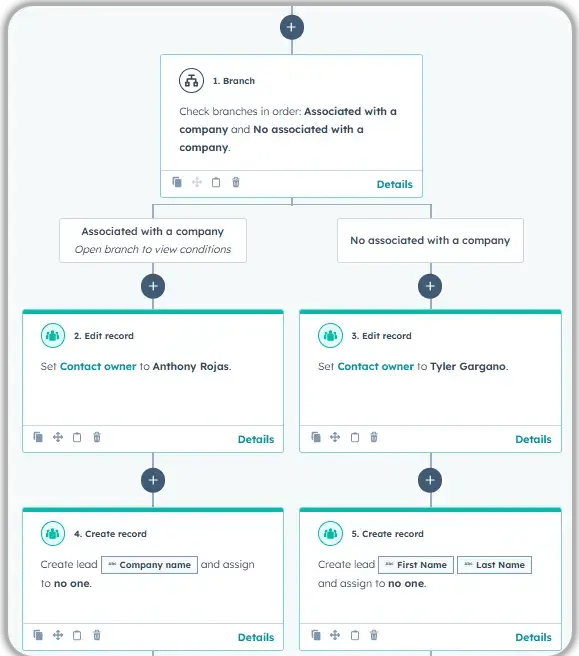
HubSpot workflow with branch logic routing contacts based on company association, assigning different contact owners, then creating leads with corresponding field mappings
Group 141 (1)
HubSpot workflow with branch logic routing contacts based on company association, assigning different contact owners, then creating leads with corresponding field mappings
Group 141 (1)
×

Part 1: Discovering What Was Really Happening

  • Conducted a detailed audit across five critical areas: workflows, integrations, properties, data quality, and user permissions
  • Documented all 198 workflows associated with ticket properties, identifying which were active, broken, or in draft mode, and mapping intended versus actual behavior with keep-or-remove recommendations
  • Investigated the Maxio billing integration to determine why subscription data wasn't reliably syncing to contact and company records, compromising renewal risk visibility
  • Audited all contact, company, deal, and ticket properties to expose redundancy and inconsistent naming conventions that were creating reporting challenges
  • Traced every pathway for lead creation, automated workflows, form submissions, and manual processes, to document why unwanted leads kept appearing in the system

Part 2: Building for Predictability and Control

  • Consolidated the form strategy from dozens of scattered forms down to three strategic forms (General Lead, Specific Lead, Follow-Up) with embedded logic to route submissions based on website URL and product vertical
  • Built automated pipelines for recurring client management: a social media marketing pipeline for six-week campaign cohorts and SEO Website Performance pipeline with 180-day check-in cycles, including automated task assignments and support ticket creation
  • Restructured the sales process into separate B2B and B2C pipelines with stage-specific automation and proper service ticket creation after close-won deals
  • Rebuilt the survey strategy to send NPS surveys quarterly to active clients only, distribute CSAT surveys three days after solved support tickets, and randomize feedback distribution while preventing survey overlap
  • Implemented lifecycle stage automation for lead qualification tied to engagement scoring, eliminating the manual update dependency
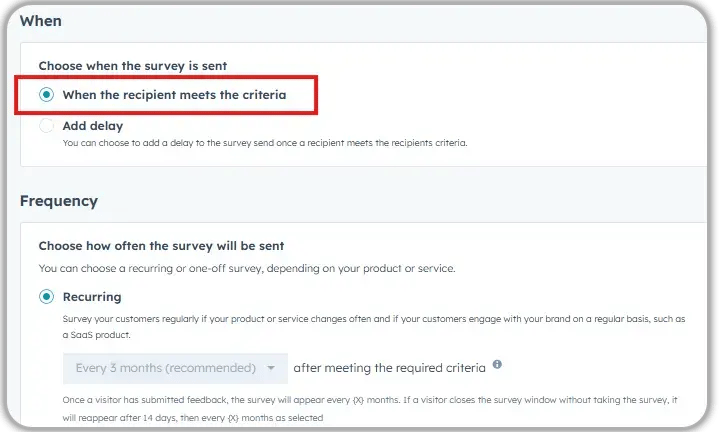
HubSpot survey automation settings showing When trigger set to recipient meets criteria and Frequency set to Recurring every 3 months after meeting required criteria
Group 141 (1)
HubSpot survey automation settings showing When trigger set to recipient meets criteria and Frequency set to Recurring every 3 months after meeting required criteria
Group 141 (1)
×
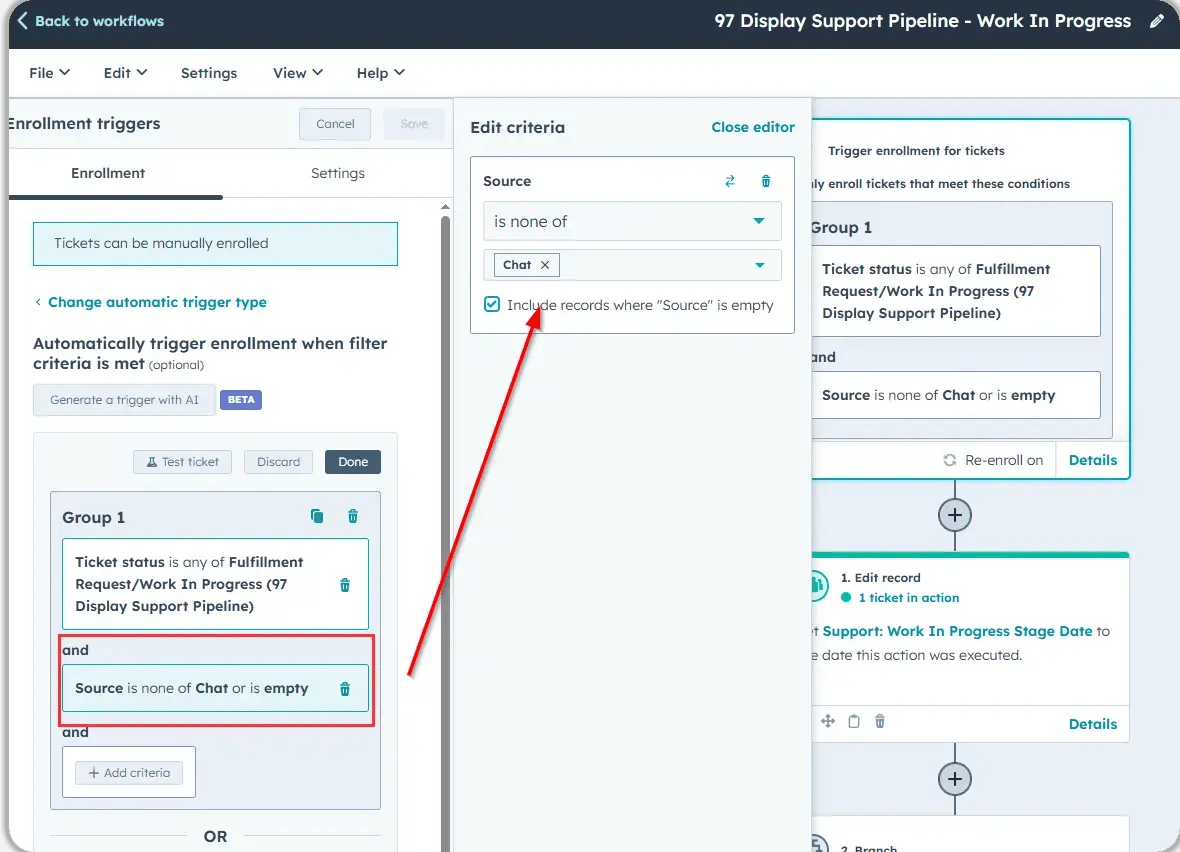
HubSpot ticket workflow for 97 Display Support Pipeline showing enrollment trigger filtering tickets by Fulfillment Request/Work In Progress status where Source is not Chat or is empty, with edit record action updating Work In Progress Stage Date
Group 141 (1)
HubSpot ticket workflow for 97 Display Support Pipeline showing enrollment trigger filtering tickets by Fulfillment Request/Work In Progress status where Source is not Chat or is empty, with edit record action updating Work In Progress Stage Date
Group 141 (1)
×

Part 3: Ensuring Long-Term Reliability

  • Standardized data across 45,000+ contact records and thousands of company records, identifying duplicates, merging where appropriate (keeping records with most recent engagement), and establishing consistent formatting conventions
  • Restructured user permissions around a clear hierarchy: two super admins, team-based visibility where reps see only their records and managers see their team's records, and private record handling for sensitive contacts
  • Rebuilt the implementation dashboard with proper date/time properties and calculated fields to accurately track strategy call completion rates, average build time, approval timelines, and individual team performance
  • Established documented backup procedures for all bulk data operations to protect against unintended changes or data loss
  • Organized workflows into logical folder structures to make ongoing maintenance and troubleshooting straightforward for the internal team
Vector (3)

Results

Before: They operated their HubSpot environment reactively, hoping automations fired correctly and manually intervening when they didn't.
After: They gained operational control and leadership confidence in their systems.
  • Financial Impact

    Improved forecasting confidence: Implementation timeline data now accurately tracks from strategy call through launch, enabling more reliable resource planning and client communication about expected delivery dates.
    Better resource allocation visibility: Time tracking recommendations provided a framework for understanding true project costs, supporting more accurate pricing and margin analysis.


  • Operational Impact

    Freed team capacity from manual work: Automated pipelines for SMM cohorts, SEO check-ins, and quarterly client touchpoints eliminated recurring manual tasks that previously consumed hours each week.
    Improved process consistency: Standardized lead qualification, proper survey distribution rules, and structured form routing meant fewer edge cases requiring manual cleanup or manager intervention.


  • Strategic Impact

    Real-time performance reporting: Leadership gained accurate dashboards showing team productivity metrics, implementation timelines, and pipeline health.
    Scalable client management processes: Automated check-in cycles and performance monitoring pipelines created structure that could handle client base growth without proportional team expansion.

Many digital marketing agencies face similar challenges as they grow: HubSpot environments that evolved organically, accumulated technical debt from migrations or rapid expansion, and automation complexity that outpaced documentation. The result is often the same: teams working harder than necessary while leadership operates without the visibility needed to scale confidently.
 
Ready to gain operational control of your HubSpot environment? Book a free consultation to discuss where your gaps might be and how we can help you build reliable systems that support growth rather than constrain it.
 
Book a free consultation to discuss your specific situation.

Others Case studies

Only Using 10% of HubSpot?

You can get these results too:

Group 14 (1) Group 14 (1)