Integrating HubSpot with Salesforce Improves Leadership Visibility & Decision-Making
Financial Services
11-50 Employees
Sales Hub |
Marketing Hub
Background
Belle Haven Investments is a wealth management B2B firm based in Rye Brook, New York, serving financial advisors, consultants, and institutional investors. They manage multiple investment strategies, including municipal and taxable bond portfolios, delivering regular performance updates to their client base. HubSpot would handle marketing automation, while Salesforce remained their system of record for client relationships.
Problem
Belle Haven was paying for HubSpot but couldn't use it effectively because their contact data, subscription preferences, and representative assignments lived in Salesforce. Without bidirectional integration, their team faced a choice: manually duplicate work across both platforms or accept disconnected marketing that ignored actual client relationships.
- Marketing Emails Couldn't Adapt to Client Portfolios: Belle Haven sends monthly performance updates for different investment strategies, municipal bonds, taxable bonds, and laddered portfolios. Without Salesforce data flowing into HubSpot, they couldn't dynamically show only the strategies relevant to each contact, forcing them to either send generic emails or manually create separate versions for each portfolio type and waste time.
- Subscription Preferences Managed in Two Places: Contacts could update their communication preferences in either Salesforce or HubSpot, but changes wouldn't sync. This created compliance risk; if a customer unsubscribed in one system, they might continue receiving emails from the other, potentially violating their preferences and damaging trust.
- Contact Ownership Wasn't Syncing: Representative assignments lived in Salesforce, but HubSpot didn't know who owned each relationship. Marketing emails had to be sent from a generic company address rather than the appropriate Belle Haven advisor, weakening personalization and relationship continuity.
- Bulk Imports Created Data Gaps: When Belle Haven's team imported contacts into Salesforce in bulk, those records weren't appearing in HubSpot. This created confusion about which contacts were actually in the marketing system and eroded trust in both platforms.
Solution
The solution required treating this as an architecture problem, not a configuration task. Belle Haven needed HubSpot and Salesforce to function as a unified system while maintaining data integrity:
×
Part 1: Diagnosis & Architecture
- Mapped how data needed to flow between systems, not just which fields to connect
- Documented every Salesforce property that marketing needed, how subscription types mapped between platforms, and where the source of truth should live for each data point
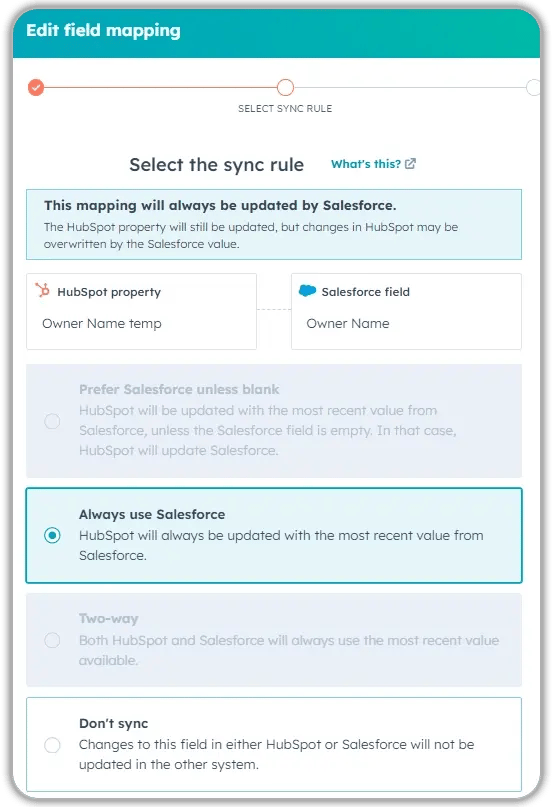
- Set most fields to "Always use Salesforce" to maintain Salesforce as the primary CRM, with strategic exceptions for marketing-specific data requiring two-way sync
- Designed subscription management workflows that listen to changes in either platform and update the other, ensuring compliance regardless of where contacts updated preferences
Part 2: Execution & Enablement
- Configured Salesforce integration with 66,000+ contacts and 7,000+ companies syncing bidirectionally
- Mapped representative ownership so marketing emails could be sent from the appropriate Belle Haven contact
- Built HubSpot marketing environment from scratch: three email templates, landing page and blog templates, signature blocks for each team member, subdomain configuration
- Created custom email module that reads "Available Strategies" property from Salesforce and dynamically displays performance report links for only those strategies, eliminating manual email creation and reducing risk of irrelevant communications
- Built six workflows to manage subscriptions between HubSpot and Salesforce, ensuring changes in either system are reflect in the other
×
×
Part 3: Control & Scalability
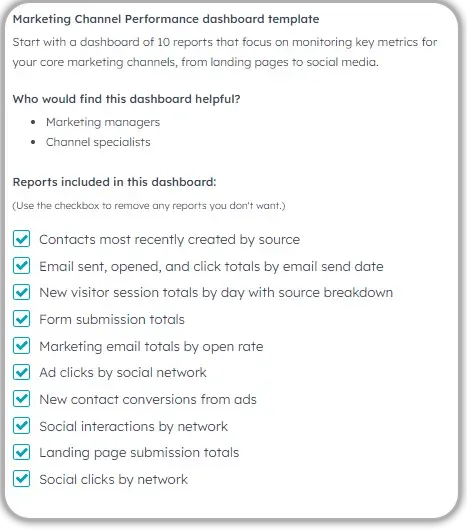
- Created custom dashboards showing contact engagement, email deliverability, subscription changes, and undeliverable emails
- Dashboards pulled data from both systems, giving leadership unified view of marketing operations
- Documented integration architecture, field mapping, and workflow logic for troubleshooting and training
Results
-
Before: Belle Haven had two disconnected systems, manual workarounds, and limited ability to personalize client communications.After: Salesforce and HubSpot function as a unified marketing and CRM platform, with automated workflows managing data sync and enabling personalized, compliant communications at scale.
-
Financial Impact
- Improved revenue visibility: Marketing campaigns could now be tracked back to contact records in Salesforce, giving leadership visibility into which communications drove advisor engagement. Representative owners synced automatically, ensuring proper attribution of marketing-influenced relationships.
- Cost avoidance: By solving the integration challenge properly, Belle Haven avoided the cost of continuing with manual processes or potentially replacing HubSpot entirely—an option that had been discussed before the engagement.
Operational Impact
- Single source of truth: Contact data, subscription preferences, and representative assignments now sync bidirectionally between Salesforce and HubSpot, eliminating the need to maintain data in two places and reducing the risk of sending communications based on outdated information.
- Improved trust in HubSpot data: With proper Salesforce integration, the team began trusting HubSpot as a reliable extension of their CRM rather than a separate system requiring constant verification.
- Better marketing-to-sales alignment: Marketing emails could be sent from the appropriate Belle Haven representative because contact ownership synced automatically. This maintained relationship continuity and improved response rates.
- Reduced manual work: Dynamic email content eliminated the need to manually create separate performance update emails for different investment strategies. The custom module automatically displayed relevant strategies for each contact.
Strategic Impact
- Real-time business visibility: Leadership gained dashboards showing marketing performance, contact engagement, and subscription management across both platforms, enabling data-driven decisions about communication strategy.
- Growth-ready systems: The bidirectional integration architecture could scale as Belle Haven added new investment strategies, communication types, or team members without requiring fundamental restructuring.
- Improved forecasting confidence: With proper data flow between systems, leadership could see how marketing communications influenced the sales pipeline, improving their ability to forecast advisor engagement and plan future campaigns.
Similar financial services firms face similar integration challenges when connecting HubSpot to their primary CRM. The systems need to work together, but they require careful architecture to maintain data integrity while enabling marketing automation.
If your firm is struggling to connect HubSpot with your existing systems, or if you're unsure whether HubSpot can integrate with your current CRM, we can walk you through what's possible and how other firms have solved similar challenges.
Book a free consultation to discuss your specific situation.
Others Case studies
Home Decor
Sales Hub |
Marketing Hub
11-50 Employees