Skip to content

How a Hair & Body Care Brand Automated Customer Retention and Recaptured At-Risk Revenue with HubSpot

Beauty and Personal Care 11-50 Employees Sales Hub | Marketing Hub
How a Hair & Body Care Brand Automated Customer Retention and Recaptured At-Risk Revenue with HubSpot
Background-icon

Background

Firsthand Supply is a B2B distributor of natural hair and body care products serving retail stores, salons, barbershops, and hospitality businesses across North America. With an e-commerce platform handling wholesale orders, the company had built a solid customer base but faced a common challenge: customers would place an initial order, then go silent.
Problem-icon

Problem

Firsthand Supply's leadership team was facing three interconnected problems that put predictable revenue at risk:

  • Revenue leakage from dormant accounts: Every order lived in Shopify, but there was no way to see patterns across the customer base. Which accounts hadn't reordered in 30 days? 60 days? 90 days? Leadership couldn't answer these questions without manual spreadsheet work, and by the time they noticed a customer had gone quiet, months had passed.

  • Missed reorder opportunities: The team knew they needed to follow up with customers proactively, but without automation, it was impossible to do this at scale. Some customers got follow-up emails. Others didn't. The timing was arbitrary. Nothing was systematic, and the sales team spent time on reactive outreach instead of working on new opportunities.

  • Forecasting uncertainty and ownership confusion: Firsthand Supply ran two distinct business motions, acquiring new customers through samples and consultative selling and managing reorders from existing accounts. But they were tracking everything in one place with no clear handoff between sales and account management. Sales reps didn't know when accounts became retention territory; forecasting couldn't separate new revenue from existing customer growth.
Light-Bulb

Solution

This wasn't a quick-fix implementation. Firsthand Supply needed a system that could automatically track customer behavior across the order lifecycle, trigger retention campaigns based on buying patterns, and give leadership real-time visibility into account health. That required thoughtful architecture, data integration, and change management.

Group 139-2 Group 139-2
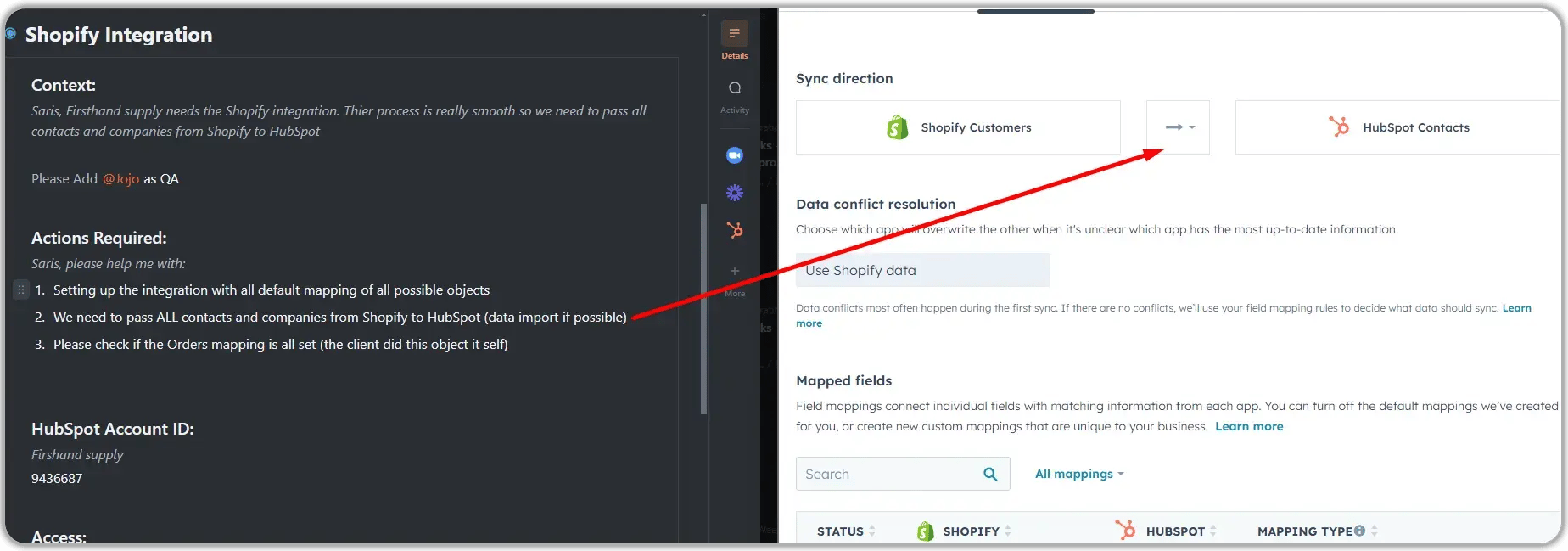
HubSpot Shopify integration setup screen showing sync direction from Shopify Customers to HubSpot Contacts with data conflict resolution settings and mapped fields configuration panel
Group 141 (1)
HubSpot Shopify integration setup screen showing sync direction from Shopify Customers to HubSpot Contacts with data conflict resolution settings and mapped fields configuration panel
Group 141 (1)
×

Part 1: Separating Acquisition from Retention

  • Mapped the complete customer lifecycle to identify where visibility broke down
  • Designed a dual-pipeline architecture: one for new business development and another for customer retention and growth
  • Separated sample requests from paid orders to track conversion rates accurately
  • Created a Shopify-to-HubSpot data sync strategy that would automatically create deals based on order characteristics
  • Defined pipeline stages that matched actual customer buying behavior (31-60 days inactive, 61-90 days inactive, account inactive)

Part 2: Building the Automated Retention Engine

  • Connected Shopify B2B store to HubSpot, syncing contacts, companies, and orders with full purchase history
  • Built workflows that automatically create deals when customers place orders over $0 and route them to the Account Management pipeline
  • Designed automated deal movement: when sample recipients place real orders, their deals automatically transfer to Account Management
  • Built a five-email reactivation sequence triggered at 31 days without reorder, spread over 30 days with timed intervals
  • Set up customer segmentation by industry (retail, professional, hospitality), deal size, and lifecycle stage
  • Built email templates, CTAs, and landing pages matching their brand for immediate campaign launches
Firsthand Supply personal care products, including hydrating shampoo, conditioner, all-purpose pomade, and styling products, with promotional banner offering free hand soap on orders over $350
Group 141 (1)
Firsthand Supply personal care products, including hydrating shampoo, conditioner, all-purpose pomade, and styling products, with promotional banner offering free hand soap on orders over $350
Group 141 (1)
×
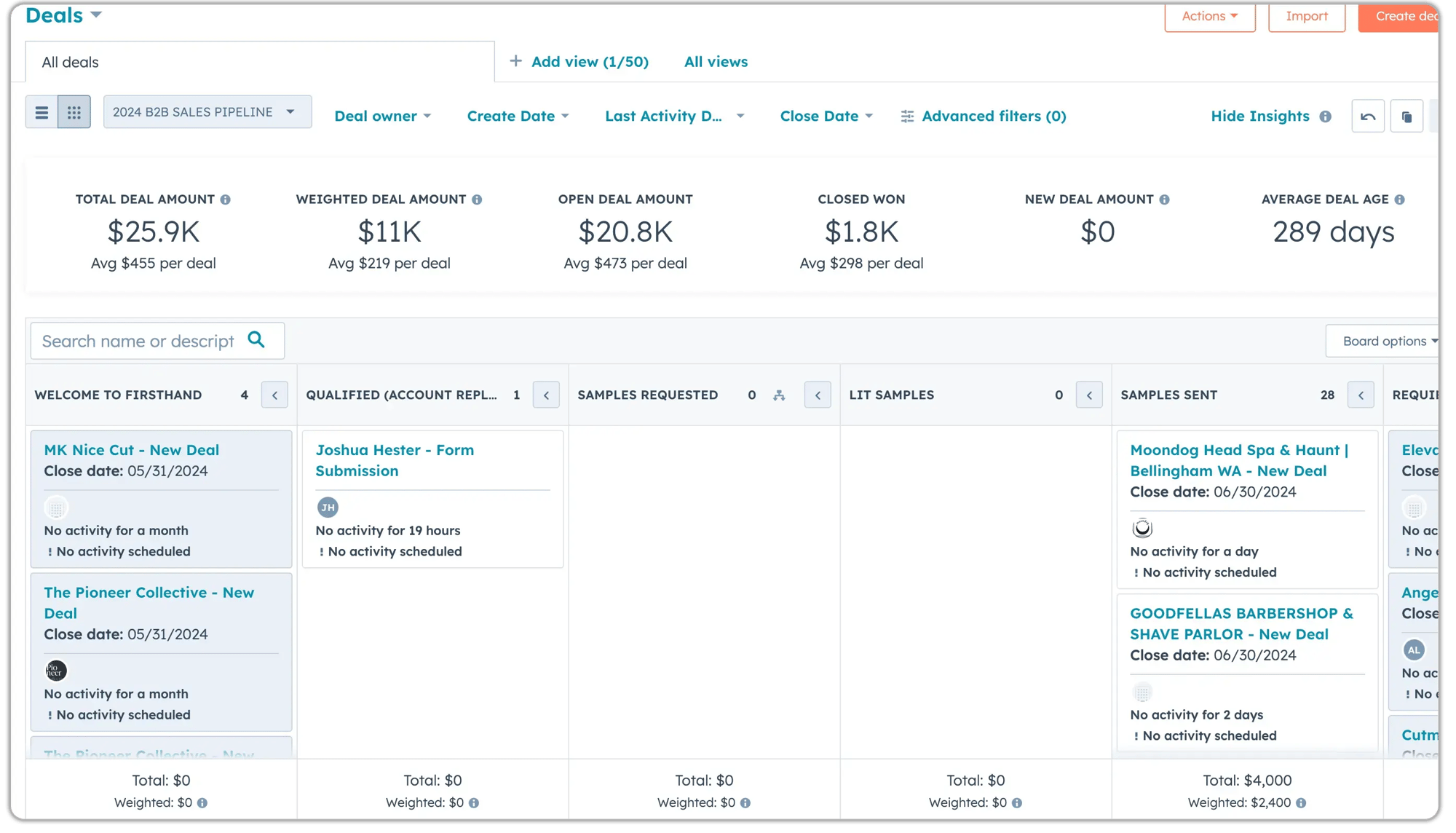
HubSpot deals pipeline board for Firsthand Supply showing 2024 B2B Sales Pipeline with deal stages and metrics, including total deal amount of $25.9K, weighted deals, and individual deal cards tracking sales progress
Group 141 (1)
HubSpot deals pipeline board for Firsthand Supply showing 2024 B2B Sales Pipeline with deal stages and metrics, including total deal amount of $25.9K, weighted deals, and individual deal cards tracking sales progress
Group 141 (1)
×

Part 3: Building for Growth

  • Created a close-lost reason tracking system so the team could learn from deals that didn't convert
  • Set up automatic deal ownership rules, ensuring every deal assigned to the right team member
  • Designed workflows to handle increasing order volume without requiring manual intervention or rebuilds
  • Established weekly reporting cadences so leadership could review account health without manual data pulls
  • Built fail-safes into automation: orders that couldn't be automatically categorized created deals in a "review needed" stage rather than dropping entirely
  • Created flexibility for future scaling as the company hires more sales reps or expands into new customer segments
Vector (3)

Results

Before: Order data stayed in Shopify. Customer retention was reactive and manual. Leadership had no systematic way to identify at-risk accounts until revenue had already been lost.
After: Every order automatically creates or updates a deal in HubSpot. Customers at risk of churning are identified early and enrolled in retention campaigns. Leadership sees real-time pipeline health and account status across all customer segments.
  • Financial Impact

    • Improved revenue visibility: Leadership can now see total order value, frequency, and trends by customer segment in real time, making forecasting more reliable and identifying which customer types drive the most lifetime value
    • Increased pipeline predictability: Separating new business from account management gave leadership clarity into two distinct revenue streams for more accurate forecasting


    Operational Impact

    • Improved follow-up consistency: Every customer in the Account Management pipeline gets the same proactive outreach at the same intervals, ensuring no one falls through the cracks
    • Clearer sales next steps: Deal stages now map directly to customer behavior (31-60 days inactive, 61-90 days inactive, etc.), showing reps exactly where to focus attention


    Strategic Impact

    • Real-time business visibility: Leadership no longer waits for end-of-month reports to understand customer health, with dashboards showing account status, order patterns, and campaign performance continuously
    • Single source of truth: HubSpot became the central system for customer relationships, pulling in order data from Shopify automatically and eliminating the need to jump between systems
Many B2B companies with e-commerce platforms face the same pattern: orders flow smoothly through checkout, but visibility ends there. Without automated retention systems, customers quietly stop ordering, and revenue erodes before anyone notices.
If you're running HubSpot and an e-commerce platform separately, or if you're manually tracking customer reorder patterns in spreadsheets, you're likely facing similar risks.
 
We help companies connect their commerce systems to HubSpot and build the automation that turns order data into proactive retention and growth strategies.
 
Book a free consultation to discuss your specific situation.

Others Case studies

Only Using 10% of HubSpot?

You can get these results too:

Group 14 (1) Group 14 (1)