How a B2B Manufacturing Company Fixed 71 Broken Workflows to Achieve Operational Scalability with HubSpot
Manufacturing
11-50 Employees
Sales Hub |
Marketing Hub |
Service Hub
Background
Flexijet operates in the B2B space, selling specialized equipment and services across North America. Like many growing companies, they invested in HubSpot to manage customer relationships and sales processes. The platform sat at the center of their revenue operations, handling everything from lead capture to customer follow-up to pipeline management.
Problem
Flexijet's leadership team was facing three interconnected problems that put operational control and scalability at risk:
- Broken automations were creating customer service failures: A critical workflow designed to create follow-up tasks based on customer timelines had stopped functioning. Consumers were not being contacted on time, and the team lacked a methodical approach to identify those who were being overlooked.
- Data quality issues were eroding trust across the organization: The contact database had 24 contacts missing email addresses, 317 missing first and last names, and duplicate records scattered throughout. Sales reps couldn't trust what they saw in the CRM. Marketing couldn't confidently segment audiences. Leadership couldn't rely on reports for decision-making. Every forecast, every campaign, and every territory plan was built on shaky data that would only get worse as the company grew.
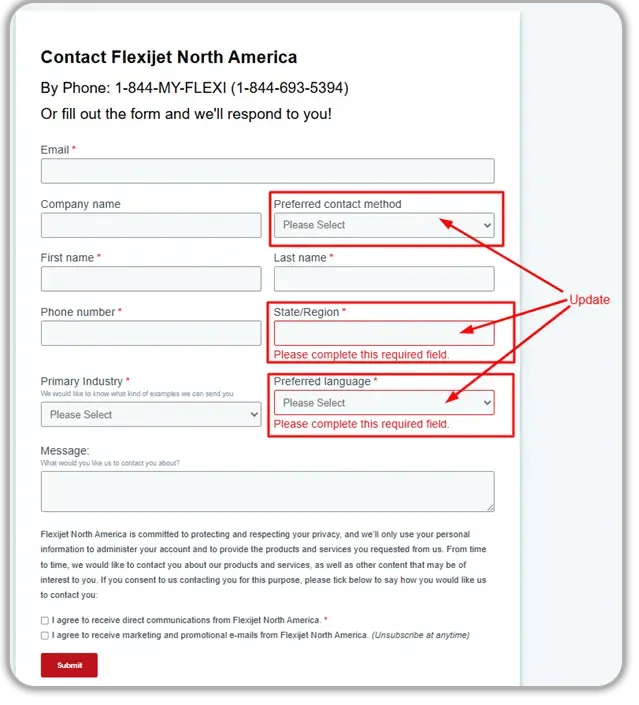
- Manual lead routing was creating response delays and inconsistency: When prospects submitted the Contact Us form, someone had to manually review each submission, determine ownership based on location, check if translation support was needed, and create the deal record. The manual process created delays in response time and inconsistency in handling.
Solution
This wasn't a matter of adding a few quick fixes. Flexijet's challenges cut across data architecture, process design, and system governance. We needed to diagnose root causes, prioritize based on business impact, and implement solutions that would hold up as the team scaled.
×
Part 1: Root-Cause Analysis and System Architecture
- Audited all 77 workflows in the HubSpot account to understand what was actually running versus what the team thought was running, documenting status, function, and issues for each automation
- Identified 71 workflows with problems, including broken triggers, outdated logic, and redundant processes that were either failing silently or creating unnecessary system load
- Analyzed the broken follow-up workflow to determine why tasks weren't generating, discovering the trigger logic couldn't properly reference the custom Follow-up Timeline field values (weekly, monthly, quarterly, yearly)
- Mapped workflow dependencies across OTF-created automations and existing client workflows to understand which new workflows replaced, modified, or filled gaps in the current system
- Examined data integrity patterns across the contact database, identifying that duplicates originated from multiple sources and that missing information followed predictable patterns that could be systematically addressed
Part 2: Rebuilding Automation & Cleaning Data
- Reconstructed the customer follow-up workflow from the ground up, building proper trigger logic that could read the Follow-up Timeline field and generate tasks in the team queue at the correct intervals without manual intervention
- Optimized and repaired workflows flagged in the audit, streamlining decision logic, removing redundancies, fixing broken enrollment triggers, and preserving core functionality where the workflow design was sound
- Cleaned contact data by identifying duplicates based on name, email, phone number, and street address patterns, then created inventories of contacts missing email addresses and names for client review and completion
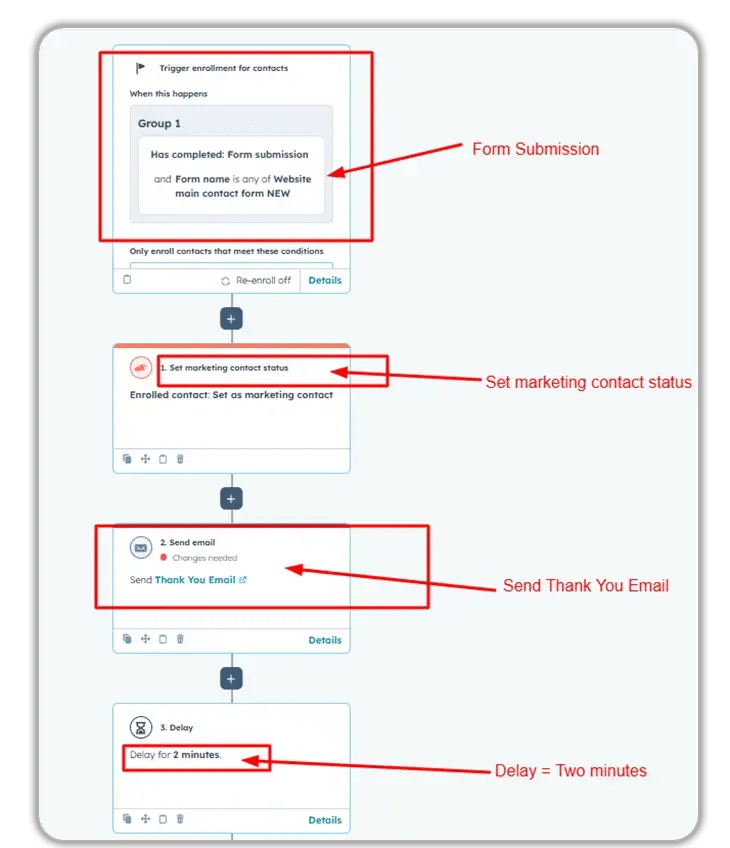
- Built automated lead routing from the Contact Us form that creates deals in the Leads pipeline at "New" stage, assigns ownership by geography (Canada to Steven Moran, USA to Kevin Black), generates translation support tasks for non-English submissions, and qualifies all form contacts as MQLs
- Implemented a lead scoring system using positive criteria (website visits to high-value pages, form submissions, email engagement, decision-maker job titles, target company sizes and industries) and negative criteria (unsubscribes, prolonged low engagement, non-target characteristics) to improve qualification accuracy
×
×
Part 3: Documentation & System Governance
- Delivered a detailed workflow audit document that categorized each automation's status and provided specific recommendations for optimization, repair, or deprecation, giving leadership a roadmap for ongoing system management
- Created a replacement mapping framework documenting which new workflows supersede legacy automations, preventing confusion about which workflows to keep active and which to turn off
- Built active lists segmented by industry based on Contact Us form submissions, providing leadership with real-time visibility into customer base composition without manual reporting
- Established data quality standards, including property naming conventions, duplicate prevention protocols, and processes for ongoing maintenance to prevent the system from degrading again
- Configured automated MQL qualification rules so contacts entering through the Contact Us form receive proper lifecycle stage classification from the start, eliminating manual qualification work and ensuring consistent lead treatment
Results
Before: Broken workflows, unreliable data, manual lead routing, no systematic follow-up process.
After: Working automations, a cleaner database, automated lead management, and visibility into system health.
-
Financial Impact
- Recovered operational hours lost to manual processes: Automating lead routing eliminated the daily task of manually reviewing Contact Us form submissions, determining ownership by geography, checking language requirements, and creating deal records, freeing the team to focus on actual prospect conversations rather than administrative work
- Improved sales efficiency through lead scoring: The scoring system allows sales to prioritize high-value prospects based on behavior (website visits, form submissions, email engagement) and fit (job title, company size, industry), focusing effort on leads most likely to convert rather than treating all inquiries equally
-
Operational Impact
- Restored customer follow-up consistency: The rebuilt workflow now generates tasks automatically based on each customer's Follow-up Timeline setting, ensuring no customer goes silent without the team noticing and eliminating the manual tracking that was breaking down
- Faster new lead response time: Automated routing from form submission to deal creation to owner assignment happens instantly without human intervention, giving Flexijet the competitive advantage of immediate response in a market where prospects are evaluating multiple vendors
-
Strategic Impact
- Real-time visibility into HubSpot system health: Leadership now has documented status of every workflow with clear recommendations for optimization, repair, or deprecation, ending the black-box problem where no one knew which automations were active or why things were breaking
- Single source of truth for workflow architecture: The replacement mapping document shows exactly which new workflows supersede legacy automations, preventing the confusion and giving the team confidence about which automations to keep active
If your team is dealing with broken workflows, unreliable data, or manual processes that should be automated, you're not alone. Many companies reach a point where their HubSpot environment has grown beyond their ability to manage it confidently.
We help businesses like yours diagnose what's really wrong, fix what matters most, and build systems that scale. Ready to take back control of your HubSpot operations?
Book a free consultation to discuss your specific situation.
Others Case studies
Home Decor
Sales Hub |
Marketing Hub
11-50 Employees