30-Day AEO Implementation Guide
Readiness audits, step-by-step HubSpot walkthroughs, and 30-day action plan.
Download Now!
Your prospects are no longer typing keywords into Google and scrolling through ten blue links. They're asking questions—to ChatGPT, to Perplexity, to Google's own AI Overviews—and getting one direct answer.
If that answer isn't you, it's your competitor.
What Is Answer Engine Optimization (AEO)?
Answer Engine Optimization is the practice of structuring your content so that AI-powered platforms—like ChatGPT, Google AI Overviews, Perplexity, and voice assistants—can find it, understand it, trust it, and cite it as a direct answer to a user's question.
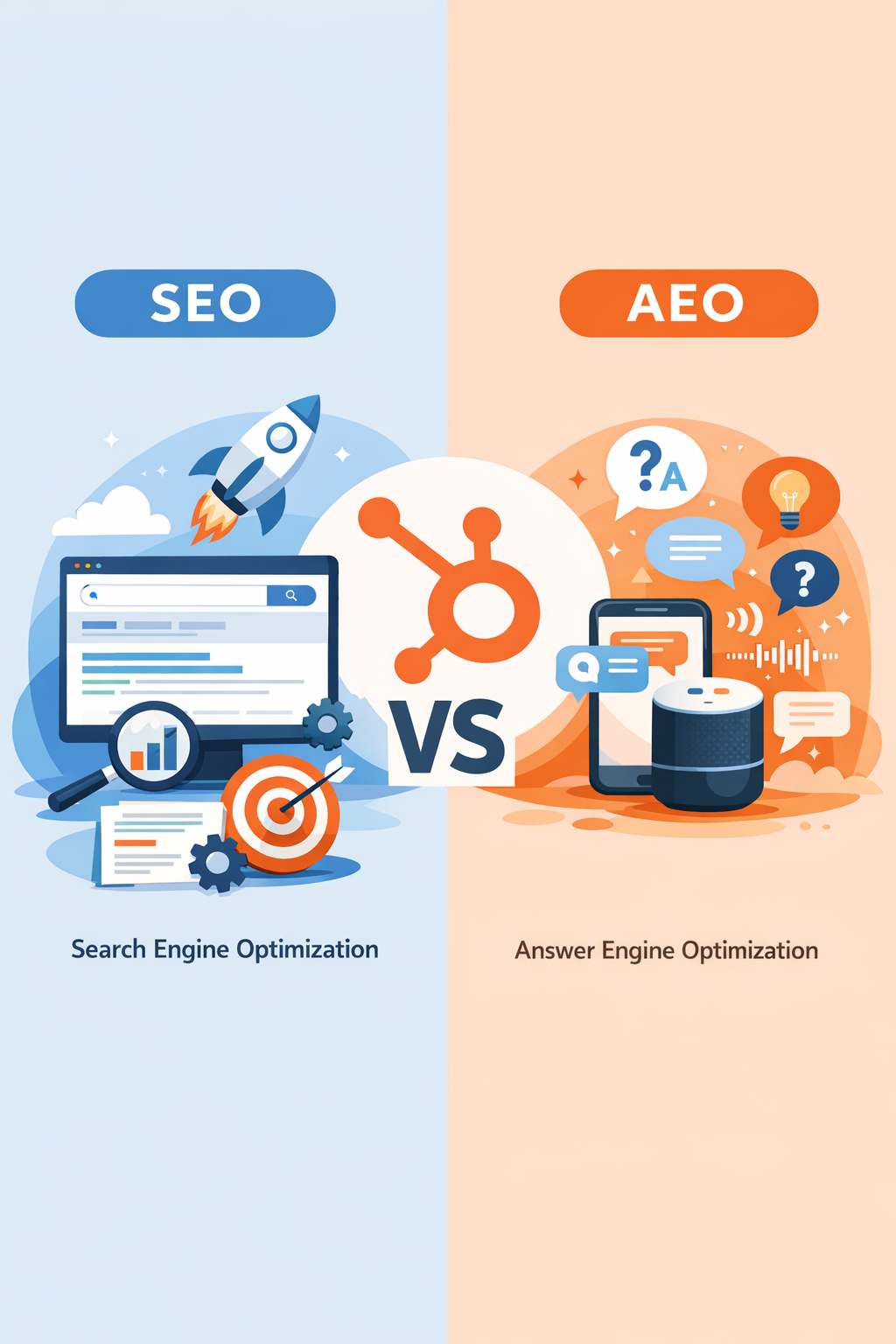
Traditional SEO asks, "How do we rank on page one?"
AEO asks: How do we become the answer?
When a prospect asks an answer engine, "What's the best way to manage HubSpot for a growing team?"—the engine doesn't show ten results. It picks one answer. AEO is how you make sure that answer comes from your content.
AEO works by optimizing three layers:
- Content structure—Formatting your pages so each section directly answers a specific question, using clear headings, short paragraphs, and scannable elements.
- Structured data (schema markup)—adding machine-readable code to your pages that tells engines exactly what your content represents—a how-to guide, an FAQ, a service, a product.
- Entity clarity—Making sure your business, your services, and your expertise are consistently described across every page, so engines recognize you as an authority on specific topics.
Why Does AEO Matter for SMBs?
AEO matters because the way your buyers find information has fundamentally changed—and your website traffic is about to reflect that shift.
Gartner projects that 25% of organic search traffic will move to AI chatbots and virtual assistants instead of traditional search by the end of 2026. That's not a prediction about the distant future. That's happening right now.
Here's what that looks like for a small business running HubSpot:
- Your best content gets summarized, not clicked. Google AI Overviews pull your information into a summary above your listing. Users get the answer without ever visiting your site.
- Your competitors get cited instead of you. If a competitor's page has better structure and schema, search engines will prefer their content—even if your content is more accurate.
- Your pipeline attribution breaks. Leads influenced by an answer engine citation won't show up as organic traffic in HubSpot reporting. They'll arrive through direct visits, branded searches, or referrals with no clear source.
The companies that take AEO seriously now will own the answers in their space. The ones that wait will spend the next two years wondering why traffic is declining while their content quality hasn't changed.

What Is AEO Instead of SEO?
AEO is not a replacement for SEO. It's an evolution of it.
Think of it this way: SEO is how you get found on a search results page. AEO is how you get selected as the answer by an engine that never shows a results page at all.
Here's how the two compare:
|
SEO |
AEO |
|
|
Goal |
Rank on page one |
Be selected as the answer |
|
Content format |
Long-form articles, keyword-rich pages |
Question-and-answer pairs, structured sections, scannable content |
|
Technical focus |
Metadata, backlinks, site speed |
Schema markup, entity clarity, structured data |
|
Keyword approach |
"best HubSpot CRM setup" |
"How do you set up HubSpot CRM for a small business?" |
|
Success metric |
Rankings, impressions, clicks |
Citations, AI visibility, mention frequency |
|
Traffic model |
Drives clicks to your website |
Drives brand visibility in zero-click answers |
The bottom line: You still need SEO. But if you're only doing SEO, you're optimizing for a shrinking share of how people actually discover and evaluate businesses. AEO adds the layer that captures the new behavior.
What Is an AEO Score?
An AEO score is a composite measurement of how visible and citable your brand is across answer engines. It evaluates whether your content is structured, authoritative, and clear enough for platforms like ChatGPT, Perplexity, and Google AI Overviews to cite you in their responses.
What an AEO score typically measures:
- Brand recognition frequency—How often your brand appears in AI-generated answers
- Citation quality—Whether you're mentioned as a source, a recommendation, or an authority (not just a passing reference)
- Competitive position—How your AI visibility compares to competitors in your category
- Sentiment analysis — Whether AI engines describe your brand positively, neutrally, or negatively
- Source authority—How much trust AI platforms assign to your domain based on structured data, content quality, and consistency
How to check your AEO score:
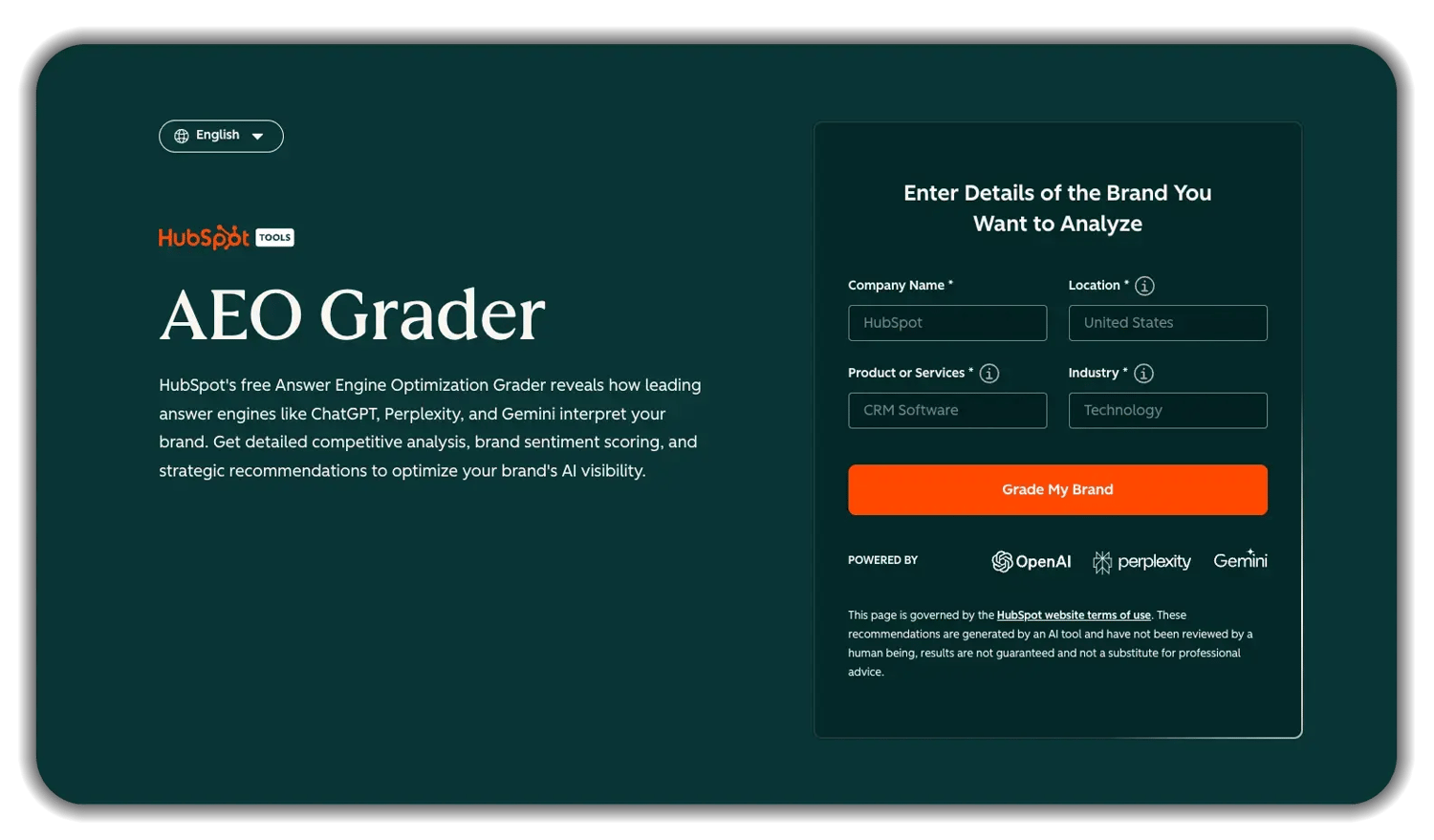
HubSpot offers a free AEO Grader tool that analyzes your brand's presence across ChatGPT, Perplexity, and Gemini. It shows how frequently you're mentioned, in what context, and how you compare to competitors.
Start here: Run the HubSpot AEO Grader on your primary domain. Use that baseline to prioritize which pages need structured data and content reformatting first.
What Is AEO Tracking?
AEO tracking is the ongoing process of monitoring how your brand, content, and pages perform inside answer engine results—not just traditional search results.
The core metrics of AEO tracking:
- Citation frequency—How often your content is referenced in AI-generated answers across platforms
- AI model coverage—Which engines cite you (ChatGPT, Perplexity, Gemini, Copilot, etc.) and which ones don't
- Share of voice—Your brand's mention frequency compared to competitors in the same topic space
- Sentiment and accuracy—Whether the citations accurately represent your services and positioning
- Content optimization score—A per-page assessment of how well each page is structured for answer extraction
Recommended tracking cadence:
Review AEO performance monthly. Weekly checks create noise from normal fluctuation. Quarterly reviews miss trends. Monthly gives you enough data to see patterns and make timely adjustments.
A practical AEO tracking scorecard should include:
- Coverage of your mapped questions (are they being answered by AI with your content?)
- Non-branded AI visibility (are engines citing you for topics, not just your company name?)
- On-page engagement for AI-referred traffic
- Pipeline sourced or influenced by AI-referred visitors
- Operational velocity—how quickly you're reformatting existing pages for AEO
Is SEO Replaced by AEO?
No. SEO is not replaced by AEO. But SEO alone is no longer enough.
Traditional search volume is declining as answer engines grow. Over 400 million people now use OpenAI products weekly. Voice search continues to grow. Google's own AI Overviews appear above traditional organic results.
What this means for your business:
- SEO still drives organic traffic from traditional search. You need it.
- AEO captures visibility in the growing share of queries that never produce a click. You also need it.
- The two strategies reinforce each other. Strong SEO content gives answer engines more material to cite. Good AEO structure makes your SEO content more likely to win featured snippets.
The smart play: Run both. Build your SEO foundation with content clusters, site structure, and keyword targeting. Then add AEO layers—schema markup, answer-first formatting, and entity optimization—on top of what you already have.
How Do You Implement AEO in HubSpot?
HubSpot gives you the infrastructure to execute AEO without needing a separate tech stack. Here's the step-by-step implementation framework, organized from foundational to advanced.
Step 1: Audit Your Top-Performing Pages
Start with your 20 highest-traffic pages and the 20 pages that rank on page one but don't yet win featured snippets. These are your highest-leverage opportunities.
What to audit on each page:
- Does the page answer a specific question in the first 2–3 sentences?
- Is the content structured with clear H2/H3 headings that match question-based queries?
- Are there scannable elements—bullets, numbered steps, tables?
- Does the page have structured data (schema markup) in the header?
- Is the business entity (your company, service, or product) clearly and consistently described?
Step 2: Reformat Content for Answer Extraction
For each priority page, restructure the content so that every section follows this pattern:
- Question-based heading (H2 or H3)
- Direct answer in the first sentence—no buildup, no preamble
- Supporting detail in 2–4 short sentences
- Scannable proof—bullets, steps, or a comparison table
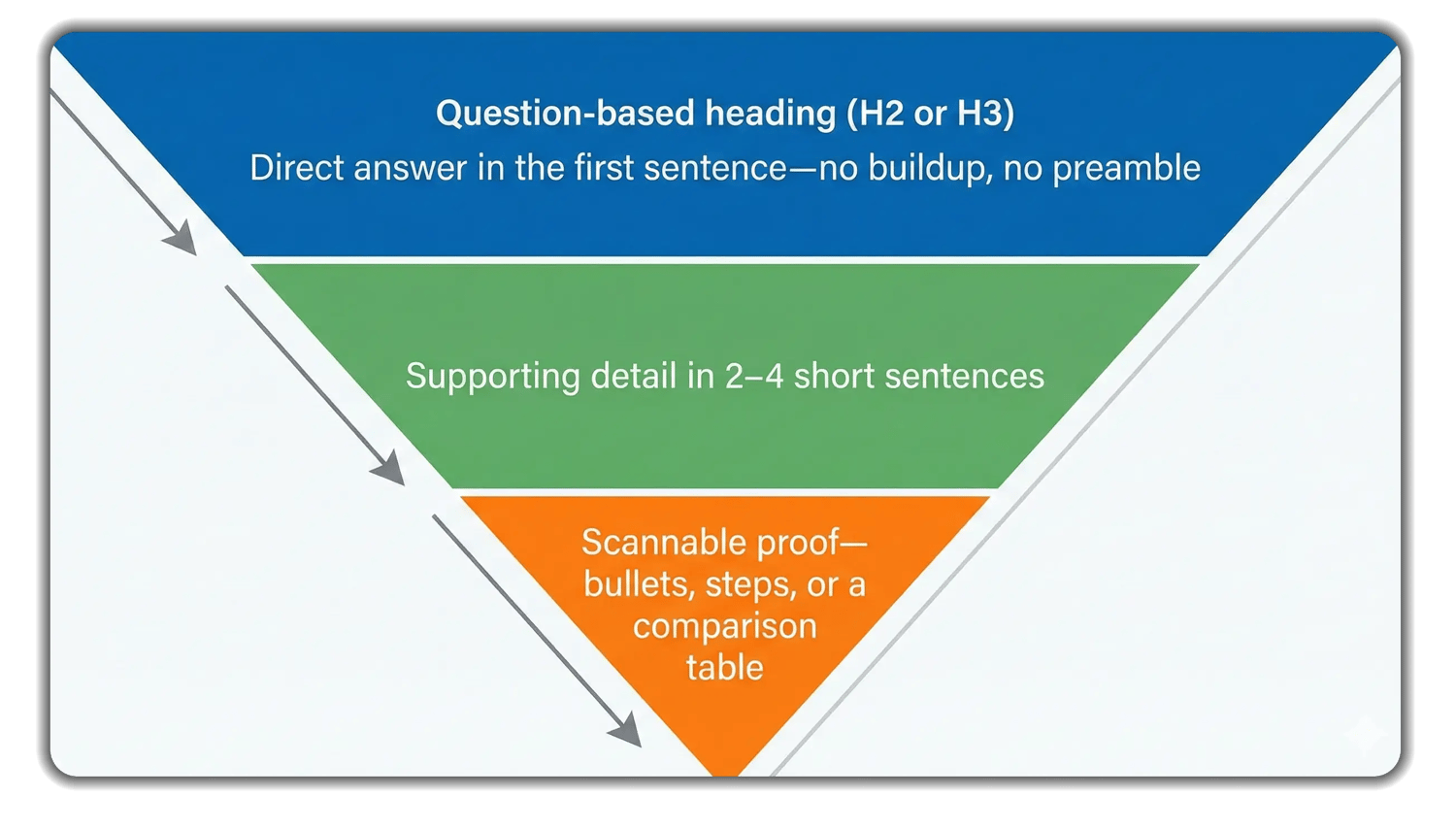 This is the inverted pyramid format. Lead with the answer. Support with evidence. Close with action.
Step 3: Add Schema Markup to Priority Pages
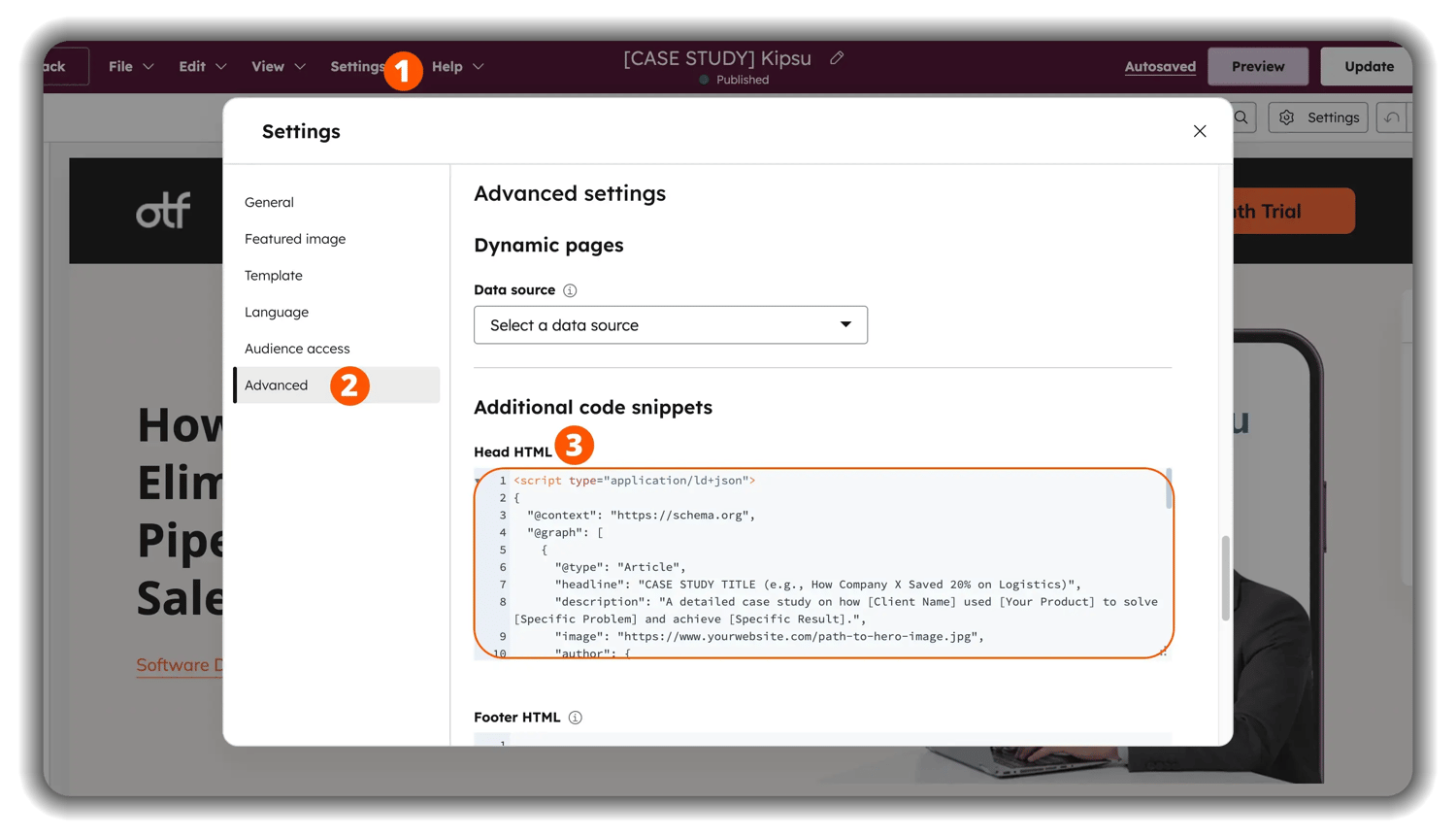
In HubSpot, you can add JSON-LD structured data to any page through:
- Content → Website Pages → Edit Specific Page → Settings → Advanced → Head HTML
- A custom HTML module placed in the page header
Priority schema types for small businesses:
- FAQPage—For any page with question-and-answer content
- HowTo—For instructional content with steps
- Article—For blog posts (headline, author, publish date, organization)
- LocalBusiness—For location-specific pages
- Service—For service description pages
- Product—For product or offering pages
Example: FAQPage schema for a HubSpot services page:
json
{
"@context": "https://schema.org",
"@type": "FAQPage",
"mainEntity": [
{
"@type": "Question",
"name": "How much does HubSpot consulting cost for a small business?",
"acceptedAnswer": {
"@type": "Answer",
"text": "HubSpot consulting for small businesses typically ranges from $1,500 to $5,000 per month depending on scope, portal complexity, and the level of ongoing support required."
}
}
]
}
Step 4: Build Entity Consistency Across Your Site
Answer engines don't just evaluate individual pages. They evaluate whether your entire site consistently describes who you are, what you do, and what you're an authority on.
Entity consistency checklist:
- Your company name, description, and services are described the same way on every page
- Author bios on blog posts include credentials and expertise areas
- Your "About" page uses Organization schema with complete business details
- Service pages each describe a specific offering with matching Service schema
- Internal links between related content reinforce topic clusters
Step 5: Implement HubSpot's Built-In AEO Tools
HubSpot has expanded its AEO capabilities significantly. Take advantage of:
- AEO Grader—Run a baseline assessment of your AI visibility
- Content Hub with Breeze—Use the content assistant to audit and optimize existing pages for answer-readiness
- Blog schema support (beta)—HubSpot's native schema support for blog posts gives AI engines clean, machine-readable data automatically
- HubDB for dynamic pages — Programmatically generate schema for product catalogs, listings, or resource libraries (covered in the advanced section below)
Advanced AEO Configuration in HubSpot
For organizations with developer resources or a technical HubSpot partner, standard page-level settings aren't enough. Advanced AEO requires programmatic schema generation using HubL (HubSpot Markup Language) and dynamic data sources.
This is where HubSpot's architecture becomes a competitive advantage.
Dynamic Schema with HubDB
Managing schema manually on hundreds of pages isn't sustainable. HubDB, HubSpot's built-in relational database, lets you generate schema programmatically at scale.
Scenario: A small business managing a catalog of services, a portfolio of properties, or a library of training courses.
Implementation steps:
- Create a HubDB table — Define columns for the data points that map to schema properties (name, price, description, image URL, and availability).
- Build a dynamic page template—Create a HubSpot page template that pulls its content from the HubDB table.
- Inject dynamic schema in the template header—Write a HubL script that loops through the row data and generates the appropriate JSON-LD schema for each page.
HubL code example:
Why this matters: When you update a price or description in the HubDB table, the schema on the corresponding page updates automatically. This keeps your structured data current—which is critical, because outdated data is a primary cause of answer engines producing inaccurate responses about your business.
Custom Object AEO
HubSpot's expanded API access to Custom Objects means you can create schema for business entities that don't fit standard categories—tours, events, recipes, case studies, or any unique offering.
How to approach it:
- Map your Custom Object properties to specific Schema.org types
- Use HubL crm_object functions to pull custom object data associated with each page
- Inject the data into JSON-LD in the page header
This effectively creates a knowledge graph of your internal business data that answer engines can read and cite. When a user asks an engine about your specific service or product, the engine has structured, current data to pull from—instead of guessing from unstructured page content.
Breadcrumb Schema Generation
Breadcrumbs help answer engines understand the hierarchy and relationships between your pages. For example: Home > Services > HubSpot Consulting > CRM Audit
Implementation: Use HubL's menu() function to traverse your site's navigation tree and dynamically build BreadcrumbList schema for every page. This reinforces the parent-child relationships between your content, giving engines a clearer map of your site's structure and topic authority.
What Mistakes Should You Avoid with AEO?
AEO implementation fails when businesses treat it as a one-time project instead of an ongoing practice. Here are the most common mistakes we see:
1. Adding schema without fixing content structure
Schema markup tells engines what your content is. But if the content itself doesn't clearly answer a specific question, the schema won't help. Fix the content first, then add the schema.
2. Ignoring entity consistency
If your homepage calls you a "CRM consulting firm," your services page says "HubSpot agency," and your about page says "marketing technology partner," answer engines can't build a clear picture of who you are. Pick your terms and use them everywhere.
3. Optimizing only for Google
ChatGPT, Perplexity, Claude, Gemini, and Copilot all process content differently. A strategy built only around Google AI Overviews misses the majority of answer engine traffic. Structure your content for extraction by any engine, not just one.
4. Letting structured data go stale
Schema that shows last year's pricing, discontinued services, or outdated team members actively hurts your credibility with answer engines. Stale data is a primary cause of inaccurate AI-generated answers. Set a monthly review cadence for your schema.
5. Treating AEO as separate from your CRM strategy
Your HubSpot CRM data—services, products, and customer information—is the raw material for your AEO structured data. If your CRM is misaligned with how your business actually operates, your AEO will inherit those inaccuracies. Align your CRM first, then build AEO on a clean foundation.
Frequently Asked Questions
What is AEO in simple terms?
AEO (Answer Engine Optimization) is the practice of making your website content easy for AI platforms like ChatGPT and Google AI Overviews to find, understand, and cite as a direct answer to user questions.
Does AEO replace SEO?
No. AEO adds a new layer on top of SEO. You still need traditional search optimization for organic traffic. AEO captures the growing share of queries answered directly by AI platforms without a click.
How do I know if my business needs AEO?
If your customers search for answers related to your services—pricing, comparisons, how-to questions, best practices—then answer engines are already shaping their perception of your business. AEO lets you control what those engines say about you.
Can I implement AEO in HubSpot without a developer?
Yes, for foundational AEO. You can add JSON-LD schema through page settings, restructure content with the drag-and-drop editor, and use HubSpot's AEO Grader without writing code. Advanced configurations like HubDB dynamic schema and Custom Object AEO require developer support.
What schema types should I add first?
Start with the FAQPage schema on your question-and-answer content, the Article schema on blog posts, and the LocalBusiness or Service schema on your core pages. These three cover the majority of queries your business should be answering.
How long does it take to see AEO results?
Initial structured data changes can be indexed within weeks. Meaningful shifts in AI citation frequency typically take 60–90 days of consistent optimization. Monthly tracking helps you see progress and adjust.
What's the difference between an AEO score and a traditional SEO score?
An SEO score measures how well your site ranks in search results. An AEO score measures how often and how accurately your brand appears in AI-generated answers across platforms like ChatGPT, Perplexity, and Google AI Overviews.
How often should I review my AEO performance?
Monthly. Weekly reviews create noise from normal AI model fluctuations. Quarterly reviews miss trends. Monthly gives you clear patterns and enough time to make meaningful adjustments.
Key Takeaways
- AEO is how you become the answer, not just a search result. AI platforms cite one source—make sure it's you.
- AEO doesn't replace SEO. It adds a critical layer that captures the 25% of search traffic shifting to AI answer engines.
- Your AEO score measures AI visibility—brand mention frequency, citation quality, competitive position, and sentiment across platforms like ChatGPT, Perplexity, and Gemini.
- AEO tracking is a monthly discipline—monitor citation frequency, AI model coverage, share of voice, and content optimization scores.
- HubSpot gives you the tools to execute AEO — from page-level schema in settings to dynamic schema with HubDB to Custom Object AEO for unique business entities.
- Start with your top 40 pages—the 20 highest-traffic and 20 ranking on page one. Restructure content, add schema, and validate.
- Entity consistency is non-negotiable. Answer engines evaluate your entire site, not just individual pages. Describe your business the same way everywhere.
- Stale data destroys credibility. Automate schema generation where possible and review structured data monthly.
- Your CRM is your AEO foundation. If HubSpot doesn't match how your business operates, your AEO will inherit those misalignments.

%20(1)-2.webp)