
How On The Fuze Turned Timeline's Disconnected HCP Wholesale Channel Into a Unified Revenue Forecasting Engine


How Do You Build Revenue Visibility When Your HubSpot Pipeline Doesn't Reflect How Your Sales Team Works?
You build revenue visibility by fixing the underlying CRM architecture... rebuilding the sales pipeline structure, deal stages, properties, automations, and reporting to reflect how the business actually operates.
Our client, Onyx Leaders already had HubSpot in place, but their CRM structure was not giving leadership a reliable view of membership growth, referral performance, or pipeline movement. The work required rebuilding the underlying system, which involved the following changes:
- Use the correct HubSpot object for each part of the sales process.
- Standardize properties that need to be filtered, segmented, and reported.
- Build pipeline stages around actual sales activities, not how records happen to be stored.
- Automate repetitive actions that depend on clear sales milestones.
- Build revenue reporting from consistent CRM data rather than disconnected deal records.

Problem
How do you know if your business has this problem?
You may have a CRM architecture problem if:
- Leadership cannot answer basic questions about new customers, revenue, or active customers without manually assembling data.
- Referral sources are stored as free text, making it difficult to monitor performance.
- Leads are being stored as deals (even before being qualified) because the pipeline was built before the CRM's Leads object became part of the sales process.
- Sales representatives rely on manual steps to create tasks, update records, or move prospects forward.
- Reports exist, but they do not answer the specific questions leadership uses to manage the business.
These signs usually point to a structural problem rather than a reporting problem. If the underlying objects, properties, and sales stages do not reflect the actual revenue process, adding reports will not fix the data... you will just be left with unreliable reporting no one can trust.
Onyx Leaders' Problem: Why Was the HubSpot Pipeline Limiting Revenue Visibility?
Onyx needed visibility into monthly new members, revenue, active member count, and average annual revenue per member. The existing HubSpot setup did not provide those metrics in a reliable way, leaving growth planning and board conversations without a consistent reporting foundation.
The referral channel had a similar problem. A meaningful share of prospects came through referral partners, but the "SSI Relationship Owner" property was a free-text field. Variations of the same partner name could therefore exist as separate values, preventing reliable referral reporting.
The sales pipeline itself was also misaligned. Seventy-two deals were sitting in stages designed for leads in pre-qualification stages rather than qualified deals. Prospects could remain in the pipeline without automation to identify inactivity or move them forward when important sales activities occurred.
This created 3 core risks:
- Limited revenue visibility: Leadership could not reliably track the membership and revenue metrics it needed.
- Unmeasurable referral performance: Referral activity could not be consistently attributed or compared by partner.
- Pipeline inaccuracy: Early-stage prospects were being represented as deals, making pipeline reporting less reliable.

Solution
To customize HubSpot to ONYX needs, below are the questions we answered...

How Do You Rebuild a HubSpot Sales Pipeline Around the Way a Team Actually Works?
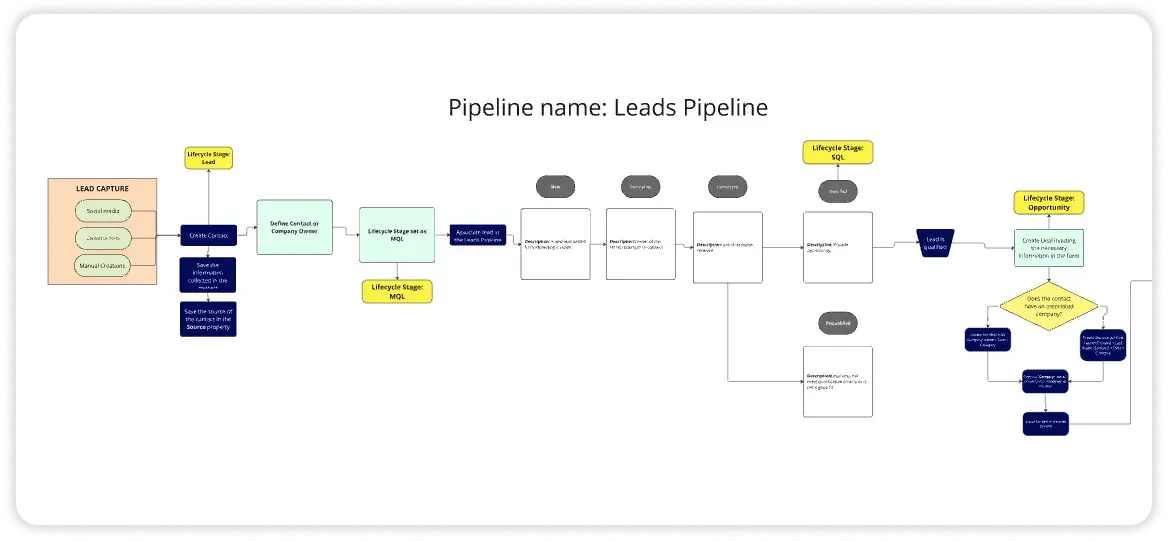
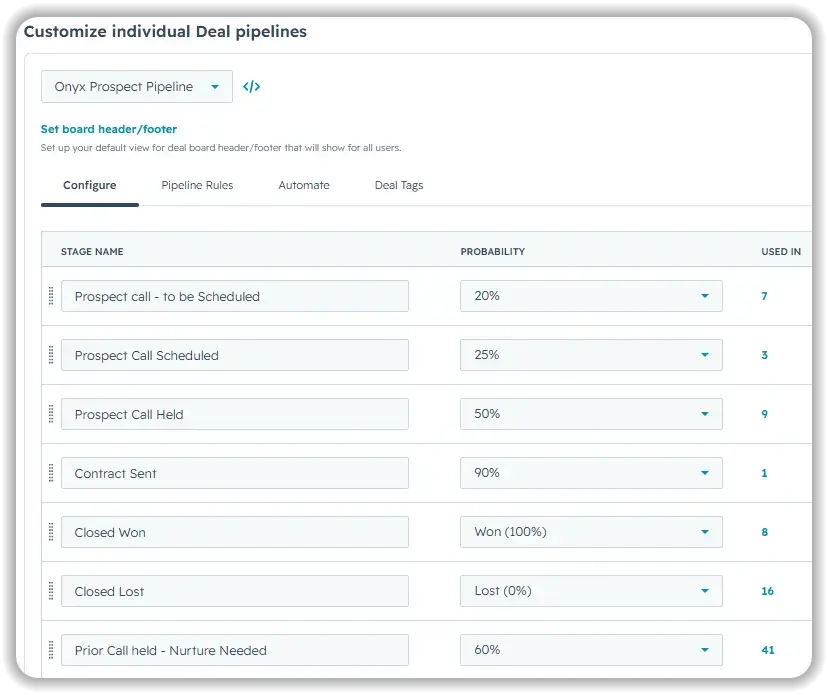
We treated the project as an architecture problem first and a reporting project second. The work moved through three stages: diagnose the existing system, rebuild the sales process and data structure, and then create reporting and governance around the new architecture.
.svg)
How Do You Know When HubSpot's Leads Object Should Replace Early-Stage Deal Records?
The Leads object is useful when a business needs to manage prospects before they become qualified opportunities. Keeping those records as deals can distort pipeline reporting when deal stages are being used as a holding area for unqualified prospects.
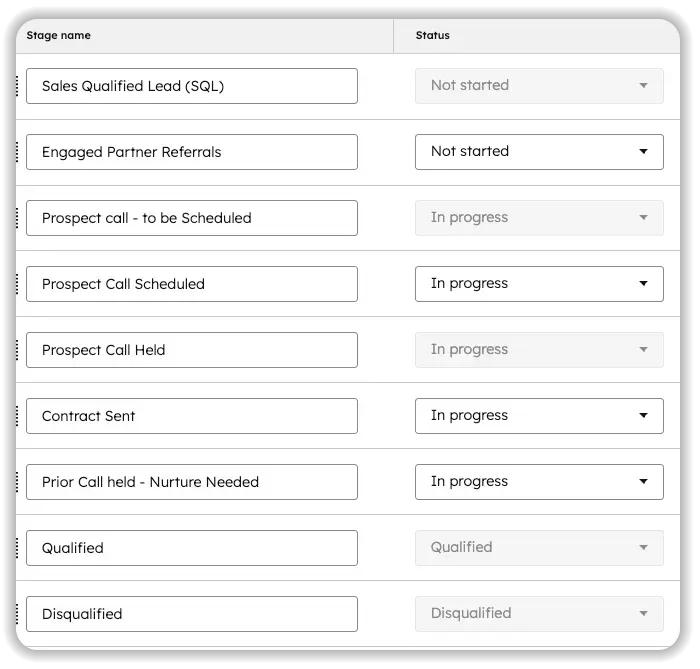
We confirmed that HubSpot's Leads object was the appropriate place for Onyx's early-stage prospects. We then activated it and recreated the existing prospect stages as lead stages so the CRM reflected the team's actual sales process.
We also migrated 68 of the 72 stranded deals into Leads. Four were not migrated because they lacked the required contact associations. Key information, including Amount, Close Date, Deal Owner, Outreach Segment, and Next Step, was carried into new custom Lead properties.
How Do You Identify Stale Leads Automatically?
A stale lead is a prospect that has remained inactive long enough to require attention, but manually identifying those records creates an ongoing review burden.
We built an automated Stale Lead tag that activates after more than 89 days without activity. This creates a live list that leadership can monitor without manually reviewing the entire prospect pipeline.
How Do You Build Revenue Reporting That Leadership Can Actually Use?
Revenue reporting should begin with the questions leadership needs to answer, then work backward into the CRM properties and calculations required to answer them.
For Onyx, we built three CEO-level revenue reports covering new members and revenue by month, active members with average annual revenue, and active members with revenue per member. We also built a Referral Dashboard with eight reports covering referral activity from partner through lifecycle and lead status.
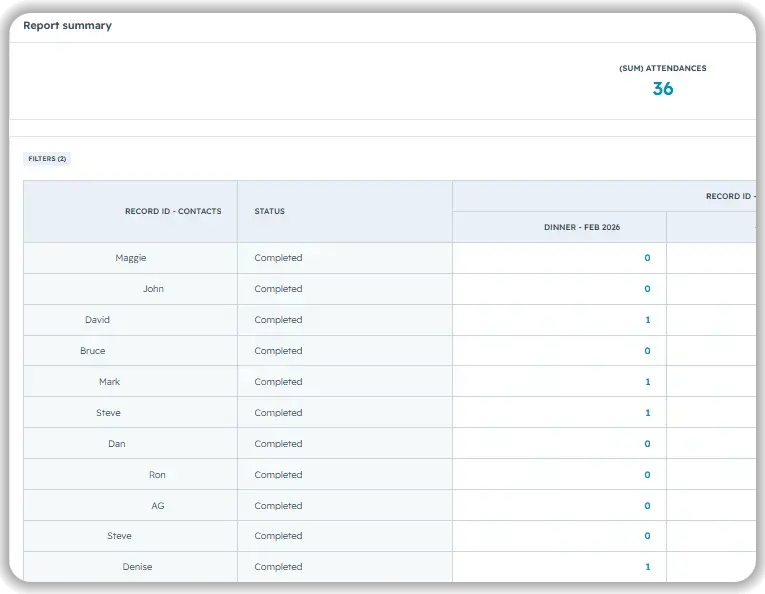
A separate sales meeting Activity Dashboard tracks meeting volume by representative, meeting type, outcome, and month. An Event Attendance report also connects marketing event data to individual contact records.
Only 13 contacts showed as "HCP Approved" in HubSpot, even though the actual number of approved accounts in Shopify was significantly larger
How Do You Make Referral Data Reportable in HubSpot?
Referral data needs standardized values when leadership wants to compare partners, sources, or channels. Free-text fields make that comparison unreliable because the same source can be entered in multiple ways.
We converted the "SSI Relationship Owner" property from free text into a dropdown containing seven named partner values. This gave the referral channel a consistent structure that could be filtered, segmented, and reported.
How Do You Automate the Sales Steps That Reps Shouldn't Have to Remember?
Automation is most useful when a clearly defined sales event should consistently trigger the same action.
We built two automations for Onyx. The first creates a "Prepare Briefing Document" task when a lead reaches the Prospect Call Scheduled stage. The second creates a renewal deal automatically when a lead becomes qualified, routing it to the Renewal Pipeline with the appropriate deal name, stage, owner, and close date.
.png?width=60&height=46&name=Vector%20(3).png)
Results
What Results Did Onyx Leaders Achieve After Rebuilding Its HubSpot Architecture?
- 72 deals identified as being in stages designed for leads rather than deals.
- 68 deals migrated into the Leads object, with four excluded because of missing contact associations.
- 7 standardized referral partner values established in the Relationship Owner dropdown.
- 2 sales automations built for prospect call scheduling and renewal deal creation.
- 8 reports included in the Referral Dashboard.
- 3 CEO-level revenue reports built around membership and revenue metrics.
- 1 sales meeting Activity Dashboard built with four meeting activity reports.
- 1 Event Attendance report built and connected to individual contact records.
These results translate into the following business outcomes:
- Improved Revenue Visibility: CEO-level reporting now surfaces new members, revenue, active members, and revenue-per-member metrics from the HubSpot data structure.
- Improved Pipeline Predictability: Moving early-stage records into the Leads object and removing the legacy prospect stages gives Onyx a pipeline structure that better reflects its sales process.
- Clearer Revenue Attribution by Channel: Standardized referral partner values and dedicated referral reporting make the referral channel measurable across the sales process.
- Earlier Identification of Bottlenecks: Automated stale-lead identification gives leadership a way to find inactive prospects without relying on manual pipeline reviews.
- Reduced Manual Sales Work: Automated task creation and renewal deal creation handle repeatable sales-process steps based on defined pipeline events.

Key Takeaways
- Fix the CRM architecture before trying to improve its reporting.
- Use HubSpot objects according to the role they play in the sales process.
- Standardize data whenever leadership needs to compare sources or performance.
- Automate actions that consistently follow defined sales milestones.
- Design executive reporting around the business questions leadership actually needs to answer.
Would this approach work for a company like mine?
This approach is particularly relevant for B2B membership organizations, professional services companies, and SMBs that rely on recurring revenue, referrals, or relationship-driven sales.
It is a strong fit when a company has 11 to 50 employees or a similar-sized sales and leadership team. Uses HubSpot Sales Hub and Marketing Hub and already has a working CRM but needs to restructure it. Tracks prospects, customers, renewals, referrals, or multiple sales processes in HubSpot. Has leadership reporting requirements that cannot currently be answered reliably from the CRM. Has sales activity or pipeline data that is being managed manually or inconsistently.
The exact implementation depends on the company's existing HubSpot objects, properties, pipelines, integrations, and reporting requirements.
Frequently Asked Questions
What is the difference between a HubSpot Lead and a Deal?
Why can free-text referral fields cause reporting problems?
Free-text fields allow the same referral source to be entered in different ways, which makes grouping, filtering, and comparing referral performance unreliable.
When should early-stage prospects be moved out of the Deal pipeline?
When deal stages are being used primarily to hold or manage unqualified prospects rather than actual revenue opportunities, the Leads object may provide a better structure.
What should a HubSpot revenue dashboard include?
The metrics should come from the organization's business model and leadership questions. For Onyx, the required metrics included new members, revenue, active members, and revenue per member.
How can HubSpot identify stale prospects?
A workflow can evaluate the amount of time since a lead's last activity and apply a property value or tag when the prospect passes a defined inactivity threshold.
Can HubSpot automatically create a renewal deal?
Yes. A workflow can create a deal when a defined qualification event occurs, provided the required properties and pipeline configuration are available.
Why should reporting be built after the pipeline structure?
Reports depend on the data being stored consistently. If the underlying objects, stages, or properties are wrong, adding reports can make the existing data easier to visualize without making it more accurate.
What is a good starting point if leadership does not trust HubSpot reporting?
Start with a CRM architecture and data audit. Determine how records, properties, pipeline stages, and automation currently work before deciding which reports need to be rebuilt.

Others Case studies


