Skip to content

How a Hospitality Tech Company Eliminated Sync Failures and Gained Pipeline Confidence with HubSpot-Salesforce Integration Optimization

Software Development 11-50 Employees Sales Hub | Marketing Hub | Service Hub
How a Hospitality Tech Company Eliminated Sync Failures and Gained Pipeline Confidence with HubSpot-Salesforce Integration Optimization
Background-icon

Background

Kipsu is a B2B software tech company that provides customer engagement software for the hospitality and multi-family industries, helping properties deliver exceptional guest experiences through digital communication tools. Operating with teams split between marketing in HubSpot and sales in Salesforce, the company relied on both platforms to track prospects from initial contact through closed deals and ongoing customer success.
Problem-icon

Problem

HubSpot served as the marketing system of record, handling all lead generation activities, including web forms, webinar registrations, and email campaigns. Salesforce managed opportunity tracking and pipeline reporting once leads qualified. In theory, data flowed between systems to create a unified view of the customer journey. In practice, the integration had deteriorated to the point where neither system could be trusted.


  • Revenue Reporting Was Unreliable: Leadership couldn't reconcile pipeline reports between the two systems. HubSpot showed different revenue figures than Salesforce, making it impossible to accurately attribute marketing's contribution to closed deals. This discrepancy undermined confidence in budget allocation decisions and prevented the team from identifying which campaigns actually drove revenue.


  • Sales and Marketing Operated on Different Truths: With 63 active sync errors and over 250,000 contact records affected by duplication issues, the marketing team was building campaigns around data that didn't match what sales reps saw in Salesforce. Leads were falling through cracks. Follow-up sequences targeted the wrong people. The hospitality industry requires precise account management; properties often have dozens of contacts, and multiple properties share management groups, but the broken association structure made it impossible to understand these relationships.


  • Growth Plans Were Stalled: Kipsu wanted to expand their marketing efforts and launch targeted campaigns for different hotel brands and management companies. But building sophisticated segmentation on a foundation of duplicate records and mismatched data would only amplify existing problems. The team needed to fix the infrastructure before they could scale.
Light-Bulb

Solution

We didn't start with quick fixes. Kipsu's challenges required understanding why the systems had diverged, what data could be trusted, and how to prevent the problems from returning after cleanup.
Group 139-2 Group 139-2
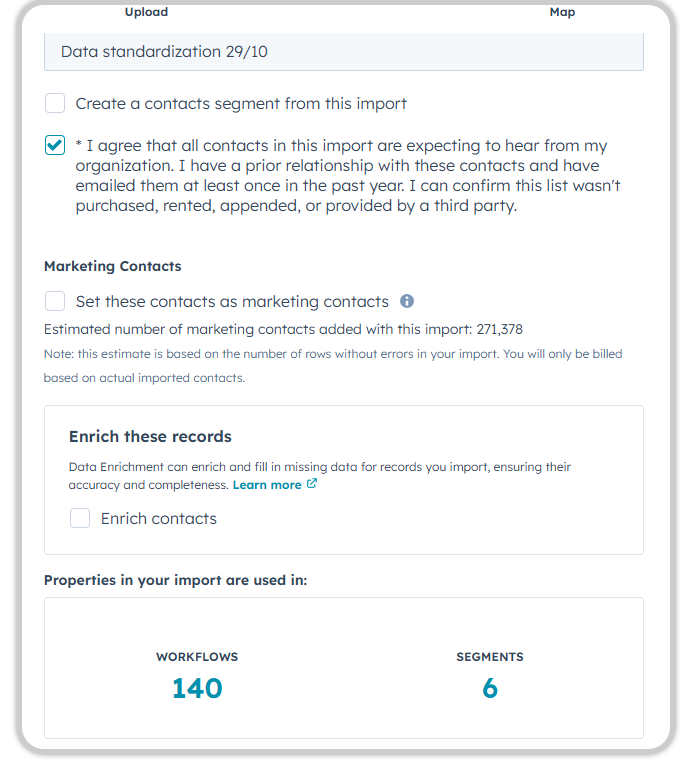
140 active Workflows analysis PS
Group 141 (1)
140 active Workflows analysis PS
Group 141 (1)
×

Part 1: Uncovering Why Two Systems Told Different Stories

  • Mapped every data entry point (forms, imports, webinar integrations, manual entry) to identify where the duplication originated. Discovered that contacts were being created without company associations, and no validation existed to prevent the same person from being added multiple times through different channels.
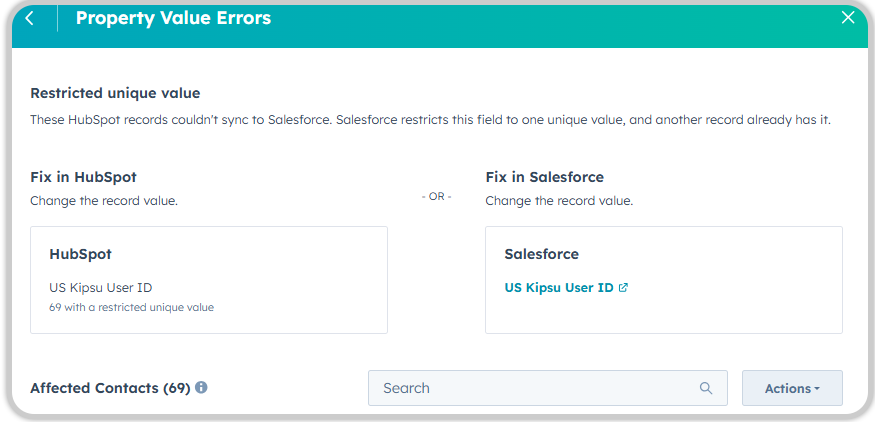
  • Documented 34 custom code errors from Salesforce Flows and Apex triggers, 23 picklist value mismatches, and field mapping conflicts. Most errors stemmed from validation rules and automation logic on the Salesforce side that blocked updates from HubSpot.
  • Analyzed 140 active workflows to identify which automations would be affected by data imports and sync corrections. Created conflict matrices showing overlapping enrollment criteria and re-enrollment risks.
  • Found thousands of email addresses with formatting issues and inconsistent phone number formats across the database, which contributed to failed matching logic during sync attempts.
  • Determined that attempting deduplication before fixing sync issues would create more problems, as cleaned records would immediately re-sync and potentially re-duplicate. Established the correct order: fix sync foundations, clean data, then implement prevention systems.

Part 2: Rebuilding the Integration Without Breaking Marketing

  • Executed a full data refresh while protecting workflow integrity. Temporarily deactivated 140 workflows, created complete backups of all objects, imported companies, contacts, and deals in sequence, and then restored automation without triggering mass enrollments or notification floods.
  • Adjusted 47 field mappings between Salesforce and HubSpot, setting unnecessary default mappings to "Don't sync" rather than attempting deletion. 
  • Cleaned 9,000+ email addresses by removing special characters, standardized name capitalization across all contacts, and unified phone number formats to a consistent structure with country codes. Built validation to prevent future formatting inconsistencies.
  • Identified 44,283 potentially duplicate company records and thousands of duplicate contacts. Rather than auto-merging, provided structured review files showing company ownership, associated contacts, deal connections, and recommended actions, allowing leadership to approve merges that preserved critical business context.
  • Systematically addressed each of the 63 sync error categories by coordinating HubSpot adjustments with Salesforce admin changes. Updated validation rules, added fallback logic to flows, and configured sync settings to avoid updating system-controlled fields.
Sync errors PS
Group 141 (1)
Sync errors PS
Group 141 (1)
×
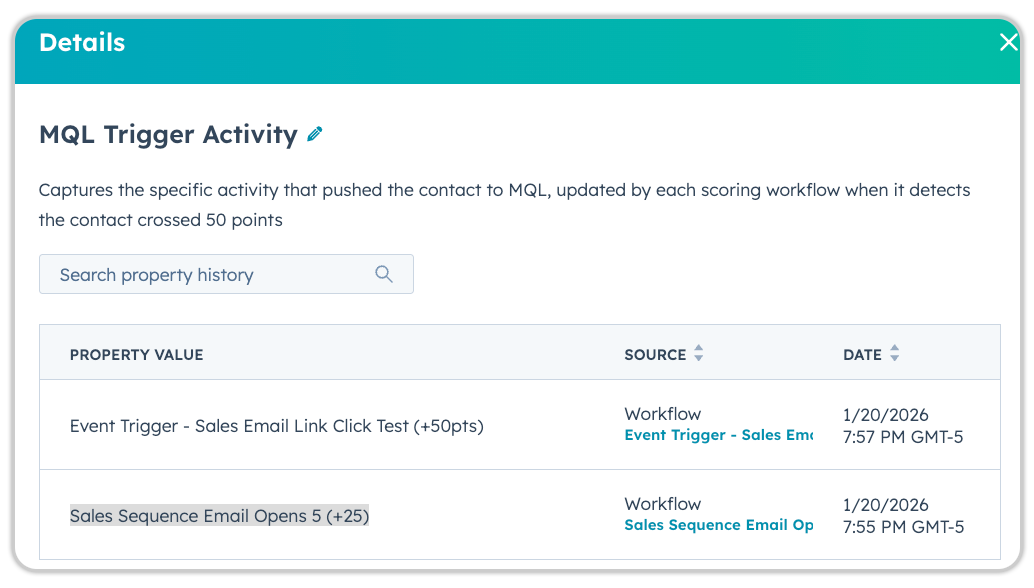
MQL trigger activity PS
Group 141 (1)
MQL trigger activity PS
Group 141 (1)
×

Part 3: Building Systems That Stay Clean

  • Built a custom reporting framework tracking contact source, MQL trigger activity, and conversion velocity. Created properties to capture "what turned this person into an MQL" for every future conversion, giving marketing visibility into which campaigns actually drive pipeline.
  • Implemented workflows ensuring new contacts are automatically linked to companies based on email domain, preventing the "orphan record" problem that had created so much duplication.
  • Designed cascading form logic allowing prospects to select major hotel brands (Marriott, Hilton, IHG, Hyatt) with corresponding sub-brand options, routing leads to the appropriate sales rep while maintaining a clean data structure for segmentation.
  • Established sync health dashboards and error-tracking processes so issues surface immediately rather than accumulating silently over months.
Vector (3)

Results

Before: Two CRM systems showing conflicting data, persistent sync errors, duplicate records preventing accurate segmentation, and revenue reports that didn't match between platforms.
After: Unified data foundation with bi-directional sync operating reliably, clean contact and company records with proper associations, and trusted reporting across both systems.

Financial Impact

  • Pipeline clarity restored: Revenue reports now reconcile between HubSpot and Salesforce, enabling accurate marketing attribution and confident budget decisions.
  • Cost avoidance through prevention: Automated validation and association logic prevent recurring deduplication costs and maintain data quality without ongoing manual intervention.


Operational Impact

  • Reduced Manual Sales Work: Sync errors were reduced to near-zero, eliminating the persistent failures that required manual intervention to reconcile data between systems. Sales and marketing teams no longer spend hours investigating discrepancies or manually updating records to match across platforms.
  • Improved Data Visibility: Sales reps now see complete account histories with 44,000+ duplicate company records resolved. Rather than piecing together information from multiple fragmented records, reps access a single source of truth showing all contacts, deals, and interactions associated with each hospitality property or management group.
  • Better Marketing-to-Sales Alignment: With thousands of contact records standardized and proper company associations in place, marketing can segment accurately by hotel brand and property type. Campaigns reach the right people, and sales receive leads with complete context rather than orphan records missing critical account relationships.


Strategic Impact

  • Segmentation is now possible for growth initiatives: With clean company hierarchies and brand associations, Kipsu can execute sophisticated campaigns targeting specific hotel management groups and property types.
  • Foundation for scalability: The system now handles new data entry points without creating duplicates or breaking associations, supporting expansion plans.
  • Confidence in decision-making: Leadership no longer questions whether the data is accurate enough to base strategic decisions on.
Similar companies face similar risks when integrations degrade over time. The gap between what your systems show and what's actually true grows wider each month. Marketing and sales drift further apart. Revenue reporting becomes unreliable.
 
If your HubSpot and Salesforce integration isn't giving you confidence in your data, we can help you diagnose what's broken and build a foundation that scales with your growth.
 
 
Book a free consultation to discuss your specific situation.

Others Case studies

Only Using 10% of HubSpot?

You can get these results too:

Group 14 (1) Group 14 (1)