Skip to content

How a Healthcare Technology Company Improved Sales Execution Efficiency to Scale In-Home EEG Services with HubSpot

Healthcare Technology 11-50 Employees Sales Hub | Service Hub
How a Healthcare Technology Company Improved Sales Execution Efficiency to Scale In-Home EEG Services with HubSpot
Background-icon

Background

Neurotech is a healthcare tech company that provides in-home EEG services to epileptologists and neurology practices across the United States. Their service connects epilepsy units, hospital programs, affiliated clinics, academic centers, and private medical groups with convenient, patient-centered diagnostic testing.
Problem-icon

Problem

Unlike traditional in-office EEG testing, Neurotech's model depends on building and maintaining relationships with hundreds of medical practices nationwide, each with its own ordering process, preferred EEG durations, and documentation requirements. Their revenue model requires consistent follow-up, accurate tracking of practice-specific needs, and reliable handoffs between sales and service teams.


  • Sales Reps Couldn't Track Practice-Specific Requirements: With thousands of medical contacts spread across epilepsy units, hospital programs, and private neurology groups, the sales team had no reliable way to capture or access critical practice details. Information about current EEG ordering processes, pain points with existing vendors, patient volume, preferred study durations, and whether practices preferred to read their own studies lived in individual rep notes. When a practice called back weeks later, reps scrambled to recall context. Without a system to document these nuances, every conversation started from scratch.


  • Lead Qualification Happened Inconsistently: The team lacked a clear framework to move prospects from initial outreach to qualified opportunity. Some practices were marked as leads when they should have been deals. Others sat in limbo because no one knew who owned the next steps or what "qualified" actually meant. Without consistent stages, the pipeline became unreliable. Leadership couldn't forecast revenue or identify which markets needed attention.


  • Parent-Child Practice Relationships Created Data Conflict: Many neurology groups operated multiple locations under a single parent organization. But when reps logged contacts from different branches, HubSpot treated each as an independent entity. There was no way to see the full organizational structure, understand the decision-making hierarchy, or avoid duplicate outreach to the same practice system. This fragmentation meant missed opportunities to expand within existing accounts and increased the risk of conflicting messages reaching the same decision-makers.
Light-Bulb

Solution

Scaling a healthcare services company requires more than CRM setup; it requires process architecture that accounts for complex organizational relationships, long sales cycles, and the need for practice-specific personalization at scale.

Group 139-2 Group 139-2
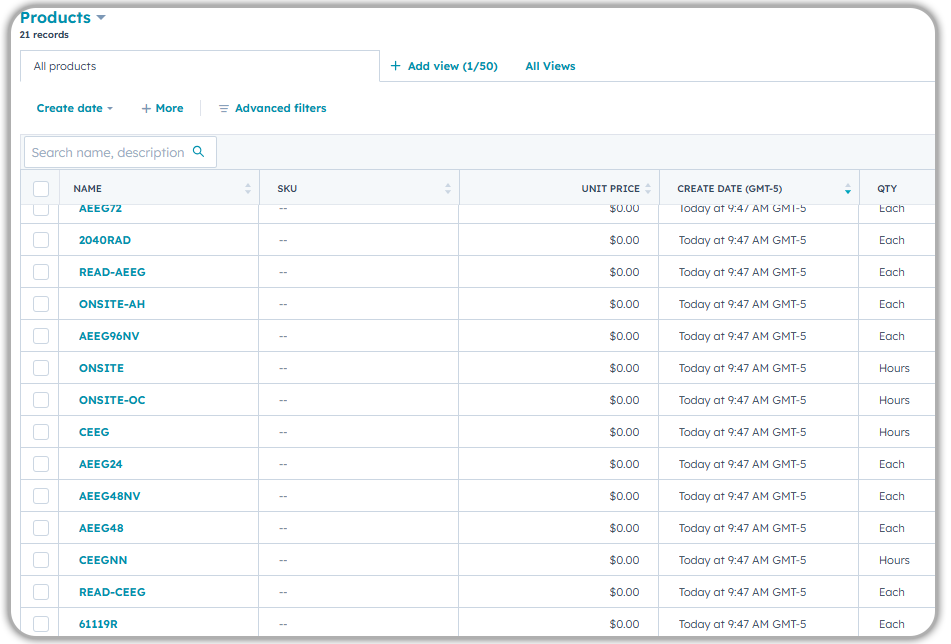
Import 21 Products
Group 141 (1)
Import 21 Products
Group 141 (1)
×

Part 1: Mapping Practice Relationships and Segmentation Logic

  • Established parent-child company architecture to map practice groups with multiple locations, preserving visibility into organizational hierarchy
  • Created a company segmentation system distinguishing epilepsy units, hospital programs, affiliated clinics, academic centers, and private groups, allowing reps to tailor outreach by practice type
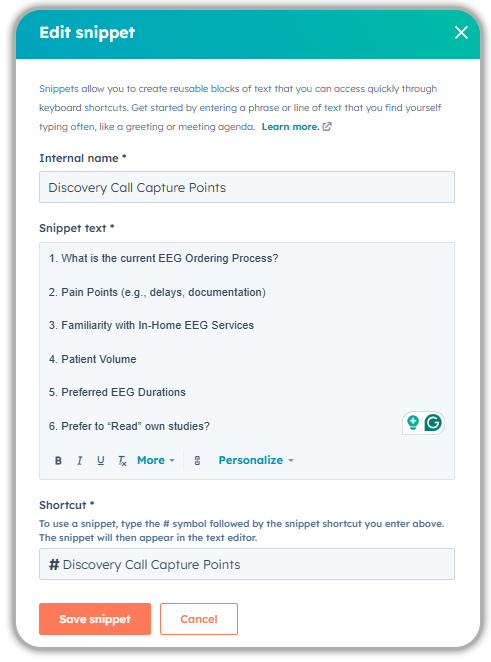
  • Built custom properties to capture practice-specific variables: current EEG ordering process, pain points with existing vendors, patient volume, preferred EEG durations, and reading preferences
  • Cleaned and structured 4,000+ contacts, removing records without email addresses that would create future data integrity issues
  • Imported 21 service offerings with custom fields for quantity tracking and revenue type classification

Part 2: Building a Qualification Framework That Matches Healthcare Sales

  • Replaced ambiguous lead stages with a clear progression that reflected how medical practices evaluate new service vendors:
  • Designed a lead pipeline with five distinct stages: New, Needs Assessed, Service Demonstrated, Qualified, and Disqualified
  • Created automation to convert marketing-qualified leads into lead records with proper ownership assignment, eliminating the gap between marketing activity and sales follow-up
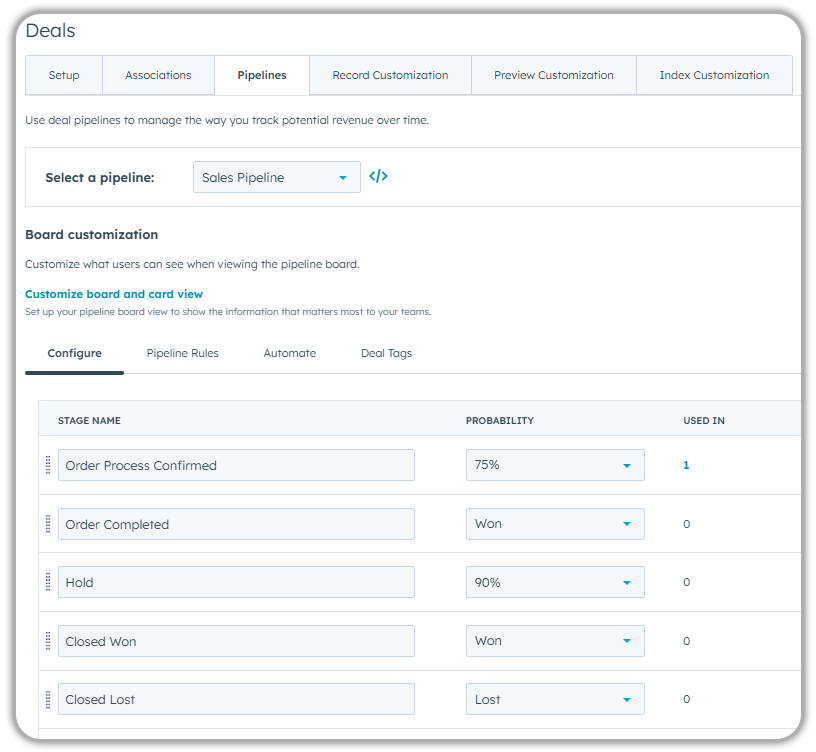
  • Built a deal pipeline with stages that matched Neurotech's order fulfillment process: Order Process Confirmed, Order Completed, Close Won, and a "Hold" stage for epileptologists who expressed interest but hadn't submitted orders yet
  • Set up workflows to automate deal stage progression, ensuring consistent movement through the pipeline and triggering follow-up reminders when deals stall.
Deal Pipeline With Stages
Group 141 (1)
Deal Pipeline With Stages
Group 141 (1)
×
Snippets
Group 141 (1)
Snippets
Group 141 (1)
×

Part 3: Creating Repeatable Follow-Up and Visibility Tools

  • Developed email sequences using HubSpot templates to standardize outreach cadence for different practice types
  • Created snippets aligned with the qualification framework, making it easy for reps to log discovery calls and capture practice-specific requirements consistently
  • Built two sales dashboards: one for front-line reps tracking daily activity and pipeline movement, and one for leadership monitoring team performance, conversion rates, and deal velocity by practice segment
  • Configured custom reports to surface pipeline health, practice engagement patterns, and geographic coverage gaps
Vector (3)

Results

Before: Sales reps relied on memory and scattered notes to track practice requirements. Lead qualification was inconsistent. Parent-child practice relationships were invisible in the CRM.
After: Neurotech now operates with practice-specific intelligence captured in HubSpot, clear qualification stages that match healthcare buying behavior, and automated systems that ensure consistent follow-up.
  • Financial Impact

    • Improved pipeline predictability: With standardized deal stages and automated progression, leadership gained reliable visibility into which opportunities would close and when, supporting more confident resource allocation and growth planning.
    • Reduced lead leakage: Workflow automation eliminated the gap between marketing activity and sales follow-up, ensuring no practice inquiry went unassigned or untracked.


  • Operational Impact

    • Improved follow-up consistency: Email sequences and templates standardized outreach cadence, removing the burden of deciding when and how to re-engage practices at each stage of the evaluation process.
    • Clearer sales next steps: The structured lead and deal pipelines gave reps unambiguous guidance on what action to take with each practice, reducing decision fatigue and increasing throughput.
    • Reduced reliance on tribal knowledge: Custom properties for practice-specific requirements moved critical context out of rep heads and into the CRM, protecting institutional knowledge and enabling smoother account transitions.

  • Strategic Impact

    • Growth-ready systems: The parent-child company architecture and practice segmentation framework positioned Neurotech to expand into new markets without rebuilding their CRM infrastructure.
    • Real-time business visibility: Dashboards and custom reports gave leadership immediate access to pipeline health, practice engagement patterns, and geographic performance, enabling proactive coaching and market strategy adjustments.
    • Improved trust in HubSpot data: By cleaning the database upfront and building automation that maintained data integrity, the team gained confidence that what they saw in HubSpot reflected reality.
Healthcare service companies face similar challenges when scaling: complex organizational relationships, long sales cycles, and the need to balance personalization with systematic execution.
 
If your team is struggling to track practice-specific requirements, qualify leads consistently, or maintain visibility across a distributed sales operation, we can help.
 
Book a free consultation to discuss your specific situation.

Others Case studies

Only Using 10% of HubSpot?

You can get these results too:

Group 14 (1) Group 14 (1)